Sunday, October 23, 2016

Fuzzy Thinking

INTRO
What was lost, found, I looked up and there it was in the distance, about 30 meters away. Not my missing phone case, it was in my car the whole time. This..
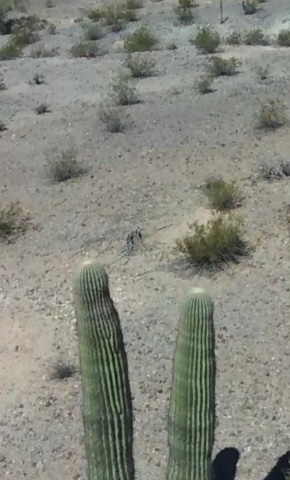
Photo a anthropomorphic frowning cactus appearing to be flipping "the bird"

WHEN SETTLING ISN'T MAKING DO

I was out flying out flying my Parrot Bebop 2 drone yesterday. I used to think it was one hot drone. Then I flew a DJI Phantom 4. Then I saw a demo of the new DJI Mavic Pro drone and took the Phantom back and pre-ordered a Mavic. Which is why I was out flying. I fly drones, not for the flying so much. That's scary. Drones are expensive. I've lost one and crashed several. I fly drones for the photos. The DJI camera gimbal and cameras are much better than what my Bebop 2 has.

But the Mavic Pro isn't likely to arrive for a while. So Bebop and me were out in the Arizona desert west of Phoenix flying and taking pictures. At the very end, packed up and about to drive off, I looked to the right and there it was: a frowning cactus. A few days from Halloween sighting it was timely. It made me think of a Jack-o-Lantern, this Jack-o-Cactus.

Desert photo of scrub, distant mountains and blue sky

Photos other drone pilots post on social media show wondrous things: cathedrals and estates, lush green or craggy snow covered mountains, cruise ships and barges on the sea or rivers, basically a whole lot of amazing places. Around these parts, in the slice of Arizona I call home, all there is is scrub and cactus.

But finding and photographing Jack-o-Cactus made me think that since I got it I should use it.

OUTRO

I wish my Mavic Pro would get here already. It's 4K camera would have taken a much sharper Jack photo. Oh well. Soon. Soon.

My drones (clockwise from top left) Parrot Bebop 2, DJI Phantom 4 and DJI Mavic Pro


Friday, June 24, 2016

Be, Still

PROLOGUE

I almost corrected Austin Kleon yesterday.

iPADPALOOZA

I'm at iPadPalooza in Austin. Yesterday I got to listen to Austin's keynote (recorded 6/23/16 at ~ 3:30 pm). Afterwards I got him to autograph my iPad. He drew over a screen capture of something I found poignant in "Show Your Work", one of his books.

Austin Kleon autograph over a thought from his book Show Your Work

I was shocked, okay, maybe that's too strong. But I was definitely surprised when he picked the Fill tool in Paper by 53 to do the autographing. Almost every bit of it he drew using the tool, except for the orange parts. As he was drawing the fingers I wanted to point out how the Pen tool was more appropriate for autographing.

BEING STILL

Luckily I stopped myself before blurting out, "For the love of God man, the Pen tool is much more appropriate for autographing." My next thought, once I steeled myself to silence, was that this is what he meant by taking something from others (stealing) and making it yours.

Image drawn with the Fill tool in Paper by 54

So here's the very first thing I drew using only the Fill tool. It reminds me of someone, just out of the bath, checking their nails. Behind them is their significant other watching them check their nails.

EPILOGUE

I need to make this change in my life. I've been dreaming about it for a while, wondering just how to do it, to get started. Thank you Austin for making it obvious how.


Monday, April 4, 2016

Crash Plan

PROLOGUE

The day my Parrot Bebop 2 quadcopter crashed began like any other day. It ended, for the drone, at 9:02 a.m., 4:32 into its second flight of the day.

TWO MISSING SCREWS CAUSED THE CRASH

At about 8:58 a.m. Friday April 1, 2016 I was flying my Bebop drone just north of Arizona's Interstate 10 off Gold Nugget Road. The weather was clear. The drone was at 31 metres AGL; it had just finished a 360 degree pan of the area. Visibility was 20 miles. Four minutes into the flight a loud pop sound interrupted the whirring of the Bebop's four electric motors. An examination of video from the drone's camera revealed that 4:29 into the flight a wobble appeared that its image stabilization system was unable to correct. The wobble lasted three seconds before the motor failed. The craft immediately began an uncontrolled descent to the desert floor some 30 metres below.

Photo taken from falling drone showing a propellor fragment (red at bottom of image) from motor number two

A thorough search of the area was begun. Owing to the nature of the brush in the area, cholla for the most part, special care was taken as the searcher lacked safety gear (gloves and goggles). The drone landed in the branches of a small fallen and dessicated tree. It is believed this cushioned its impact, sparing major damage to the airframe. The Bebop's battery was found on the ground a few centimeters away. It is believed the battery remained attached to the airframe during its fall, separating at the moment of impact. The battery sustained a puncture with cracks and tears emanating from a point on its starboard side several centimeters aft of where it attaches to the cowling.

About 30 minutes after the crash the partial remains of the propellor, one vane, from motor number two were found approximately nine meters from where the Bebop came to rest. As of the time of this writing the location of the two remaining propellor vanes remain unknown.

After a tear down of motor number two it was determined that two of the three screws mounting the motor housing to the airframe's aft-port pylon had not been attached. It is believed vibration during the three hours of total flight time caused microcracks in the propellor that resulted in its catastrophic failure.

Photo of motor number two mount showing two empty screw holes

EPILOGUE

Language matters. Use the lingo the people you hang around with use. Learner, trainee, student: Use what the locals use.


Wednesday, March 16, 2016

Turned Around

PROLOGUE

Sunday morning my best laid plans for getting to the Learning Solutions conference in Orlando, Florida got turned around. News about flooding in Louisiana and Mississippi, my direct route, and word of more of the same on my alternate route through Arkansas encouraged me to play it safe. So I made it as far east as Austin, Texas and and turned around for home.

GIVING MYSELF THE GIFTS OF TIME AND FLIGHT

In Austin I decided to try for my alternate route through Arkansas. Increasingly dire warnings on the news and Facebook friends postings about heavy weather nixed that idea. I emailed the conference producer that I wouldn't be able to make it to present my session. I felt a kind of despair for a little while. What made the fear fade was hearing from a friend that I needed to ask God for guidance then decide then let go. So I did.

A hundred miles west of Abilene, Texas for no particular reason I pulled off Interstate 20 and walked around a bit. I had my BeBop drone with me. I wanted to take it aloft but was cautious as it was windy. In the end I let it fly. And then I was rewarded by this photo.

Photo of tilled soil with tire tracks turning away from a weedy field

I decided then to go off the Interstate. I got to visit several very small Texas towns. I experienced life through others' lenses. I flew my drone under a bridge over the Pecos River. I got to look down into what I think was a mine entrance. I fumbled a bit trying to fly over and around a moving train. I have to work on being steady at the controls though. But I did get to peer down into some of rail cars passing below.

EPILOGUE

A few days before Christmas 1977 I decided to take a couple weeks leave from my posting at the US Navy's training command at Corry Station, Florida. Early one Saturday morning I packed my sea bag into the trunk of my lemon yellow Toyota Celica and headed west on Interstate 10. My goal was spending the holiday with my family in Colton, California some 2200 miles distant. I recall it was quite foggy as I sped along. Around Mobile, Alabama it started to rain. Hard. It continued to rain well into Louisiana. The gas stations I stopped at to refuel were inundated by water. In Louisiana there's this long stretch of Interstate 10 that's elevated. I have a strong memory of my Celica and me hydroplaning over the flooded bayous. By the time I got to Beaumont, Texas the clouds and rain had mostly given way to clear blue sky. Topping off at a Texaco station I asked the attendant how long to El Paso. His reply remains vidid in my memory: "Worry about that tomorrow."

So here I am, my 60 year old self, enjoying another tomorrow. I have time.


Saturday, March 12, 2016

5 a.m.

INTRO

It's 5 a.m. on a Saturday. I'm on a path that I'm not sure where it goes.

FADED PHOTOGRAPHS OF VIVID MEMORIES THAT MAY NOT HAVE HAPPENED, YET

I'm on my way to #LSCon, the Learning Solutions Conference, produced by the eLearning Guild. But that's not what this post is about. I'm on my way to Orlando, Florida where the conference is held. To get there I have to travel along a path from my distant past.

The end of 1977 found me at Corry Station learning the finer points of being a technical sailor in the US Navy. Corry Station, in ancient times, was a naval air station. I have a vivid memory walking across the old runway apron and tripping over an old aircraft tie-down cleat. It was set, recessed, into the concrete, a small loop of rusted iron. At least that's how I remember it. I think I took a photo of it. If I did I lost it. It isn't in my Flickr, one of the apps I use to record photos.

Screen capture of a grayed-out Flickr screen

At this very moment I'm in El Paso readying myself for today's travel. I'm connected to the Internet via a 3G Verizon mobile device. In its day it was fast. Today it's like molasses. A few minutes ago I was in Flickr looking for old photos. After about two years of pictures the screen turned gray. The photos are there, on a server somewhere, but not here in front of me to verify my memory.

I hope to travel 600 miles today just like I did yesterday. Except that yesterday I barely made it 400 miles. I kept stopping, for reasons of health and curiosity, to pass some time among memories. I flew my BeBop drone to give me a perspective I didn't have back then. If you follow me on social media expect lots of fisheye views of the ground from 30 metres up the next few days.

OUTRO

In 1977 parts of Interstate 10 hadn't been completed. Today, I hope to find a detour I took around one such unfinished section. Only I'm not 100% sure where it was. One end was at Fort Stockton, Texas. I recall a cattle watering tank and an ancient Ford Aeromotor (a windmill). If I find them, expect a flyover. If I can't find it maybe I'll do a sketch of the vivid memory of something I think I saw 39 years ago for a moment.


Saturday, March 5, 2016

Hey Aviator

PROLOGUE

I'm an aviator. Ok, not really. But I do wear glasses and own a drone quadcopter. The point is I drive something that flies.

Photo of Bebop 2 drone in flight next to a saguaro cactus

HOW LOW CAN YOU GO?

For as long as I can remember I've wanted to _______. But I have a short attention span. It doesn't help I'm attracted to shiny objects. So along the way of my life I've half started a lot of things. But now that I'm an OldPa (a term I remember from an old Lionel Barrymore as grandfather movie) I have a little more disposable income.

So the other day I used some to buy a Parrot Bebop 2 drone. I needed one to respond to an RFP (Request For Proposal). Now that I've responded I have a cool red toy to play with.

Speaking of play, I like to have fun while learning. One way I have tons-o-fun learning is by participating in EdCamps. In a nutshell they're gatherings of teachers where everyone is a genius. I've lost count of how many I've participated in. Anyway, at one of them I noticed how learning can be influenced by environment. I was in a first grade classroom. Not only was everything small, like models I glued together as a boy, most things in the room were scaled down, maybe 3:1. I had expected that.

What I hadn't expected was how low things on the wall were. I'm 6 feet and 5 inches tall. I had to look down at learning aids placed on the walls. Something a six year old looked straight into I had to peer down at. This has AHA! moment kick-started my thinking on learning environments.

THE TOPS OF THINGS

When I spun up the props on my Bebop and got it about three metres in the air I saw a whole new world. Tall as I am I mostly look down at things. Of course I look up at stuff too. But being a creature of habit I tend to not really notice the usual stuff around me. Taking a look at my surroundings from higher up than usual really opened my eyes. Cliche though it may be to say I saw a whole new world it's true.

Photo of the top of a saguaro cactus
RETRACING OLD STEPS

Cactus tops, tree tops, house tops, my bald head are all things the drone and me have captured. I don't expect the novelty to wear off for a while.

In 1977 I entered active duty with the US Navy. I did a lot of traveling over the next six years. One of my more memorable trips was driving my then new Toyota Celica from Corry Station near Pensacola, Florida to my boyhood home in California. The 2209 mile trip took me around 44 hours. I remember bits and pieces of sights along the way. What I remember most though was how big and diverse the southern United States is.

In seven days I start driving from my home in Arizona to a conference in Orlando, Florida. I'll be in my new Honda CR-V. I expect to make a lot of stops along the way. I'm looking forward at what the drone's view reveals.

EPILOGUE

What the drone really does is expand my view just a little bit. My eyes are almost 40 years older than they were in '77. It occurred to me just now how Google Earth lets me look down. The drone makes it more personal, so much more up close. I think that's what an aviator might feel flying through the air. I'm not a passenger peering out a window at the world going by. I'm choosing the path and experience what's coming up.


Tuesday, February 23, 2016

Conf it up

INTRO

What do you do when the concurrent conference session you were really interested in falls flat?

THE LEARNER IN THE MIRROR

I've done it. I'm in a conference session whose title and description really resonated with me. But then a little into it I catch myself browsing the web on my mobile device because the actual presentation isn't all that interesting.

Image of distracted listeners

Over the past 12 months I've gone to a dozen or so conferences. Most were EdCamps; the others were sponsored by professional development organizations.

As a presenter it stings when I don't connect with the people in the room. Heads go down and it's plain they're doing something else. Mea culpa. Reflecting on this on the long drive home from EdCampVentura Sunday I wondered how a presentation might play out if it was more conversational. That's where the root of conference comes from: conversations among people brought together by similar interests.

OUTRO

When a presenter asks their audience to put their mobile devices away are they doing it to avoid disruption? Or might they be saying, "What I have to share isn't all that interesting." Maybe an appropriate response is following that basic tenet of EdCamp: Vote with your feet.


Tuesday, February 9, 2016

An Old Dude Gets Whyze

INTRO

In my personal life rarely do I have a plan.

GIVING UP CONTROL MADE ALL THE DIFFERENCE UNTIL IT DIDN'T

A basic tenet of EdCamp is to vote with your feet. Not getting what you came for? Vote with your feet: Let them take you where you might.

Almost 40 years ago I gave up control of my life for six years. At 20 I enlisted in the US military. In the Navy to be precise. I made choices, sure. But for the most part others made the decisions. Except they were really my choices. Confused? So was I. At least until I read a blog post by @davidtedu on a writing technique known as The Three Whys. The way I figure it asking why three times takes one deeper into a subject. This allows one to glean insights that might have been missed during a more conventional process of analysis.

Why did I join the Navy? To have an adventure. To have a chance at living a life beyond the commute here and there existence I'd known for far too long. Why did I want adventure? Because I felt my life to that point resembled a connect-the-dots puzzle where predefined forms reveal themselves after a period of focused effort. The point is the forms were there all the time. It was live by the numbers 28-29-30 and there you are hello Mr. Easter Bunny. Why do I have a problem with numbers? Because life isn't about counting. Life is more about formulating. And there I got brought up short. Because I don't like to plan. If I really believe in formulating, in thinking deep thoughts and applying, them isn't that planning, which I have mentioned I'm not a big fan of?

AN IDYLLIC YEAR LIVING IN A JUNGLE

Diego Garcia. I spent one of the best years of my life there. Located a little off the equator in the Indian Ocean it's a coral atoll and jungle. The thing about jungles is they smell. Jungles smell bad. It's because jungles are in continual renewal. Old stuff falls to the jungle floor where decomposes. It feeds new life. I had to travel something like 11,000 miles from home to learn that lesson.

I got there after a week riding a C-141 transport plane all the way from Norton AFB (Air Force Base), to Travis AFB, to Hickam AFB, to Anderson AFB, to Clark AFB, to.. Trust me on this point: It took a whole lot of tos to get me where I wanted to be.

Collage of images
Which brings me back to choices. Diego Garcia in 1978 was isolated duty. I volunteered to go there so the Navy obliged and sent me. I learned that I could usually get what I wanted by asking for stuff few wanted. It wasn't a plan. It was a formula.

UP UP AND HEY

I've voted with my feet twice in the last couple weeks. At Design Camp San Diego and EdCampPerris I listened for a time then got up and moved on. What got me moving was a static message, a conversation where one person was doing most of the talking. I know this as teaching. What I'm much more into these days is learning. It's like traveling by air. You can get there slowly by balloon. To go the distance, to make the big leaps, takes oomph, the sort of thing a rocket is good for. The great thing about EdCamp are conversations, where everyone speaks up and shares. It's a kind of design thinking. Everyone speaks up. Different things resonate with different people. Bonds of empathy bring people together for deeper collaboration.

OUTRO

So I asked why a few times and I got whyze. With this whyzdom came the realization that I don't much like being told how something works. I'd much rather listen to a multitude of others share how they think something works and then try it on for size so I can figure out how it works. Thank you David for why assist.


Thursday, January 7, 2016

Learning is motion

INTRO

Initial meetings with clients can be illuminating.

LEARNING ENABLES HEARTS AND MINDS TO GET MOVING

The other day I met with a new client. Their team and I are in the "getting to know you" stage. They showed me a number of slides with data on how many courses were in production, how many were live on their LMS and how many courses were taken by their employees.

Sketch of a human body showing its heart and brain

When I asked about results, what we refer to in the business as return on investment, they drew a blank. Sadly, this is typical. Their data tell a story about butts-in-seats: developing and completing training. But learning is so much more than that.

Don Wettrick teaches a course on innovation at his high school in Indiana. In a Periscope video this morning he talked about how he's considering moving away from traditional grading to PASS/FAIL.

Reflecting on his thoughts I got to thinking that the methods my client and Don use to assess learning misses on efficacy. How well did they achieve their planned result?

One (among many) things I've learned after two years of professional development (PD) alongside K-12 teachers is that mistakes matter. They're a significant part of the learning process. My client, tracking the data they do, don't have visibility on the number of mistakes their organization is making. They don't know if the training they've developed has moved the organization towards its planned result.

OUTRO

I would suggest to Don that grades are important. PASS/FAIL doesn't capture the mistakes learners make along the way. I don't believe grades are a carrot to entice learners to do better for the sake of a higher grade. In Don's Pure Genius he writes how learners say what they're going to do, how much their ultimate work will be worth and then assess along the way and at the end. I believe learning is much more than butts-in-seats. It's about enabling learners to get their hearts and minds in motion doing stuff. Honor the mistakes learners make along the way. Keep the grades.


Monday, December 28, 2015

Wanted Moster

INTRO

I used to be a Hagar the Horrible fanboy. The Dik Browne strip was a hoot and helped me get my day started right. One of my fav strips was where a bartender asks Hagar what he wants. His reply is something I cherish to this day.

WHAT DO I WANT? WHAT DOES ANY VIKING WANT?

Today's #ds106 daily create challenge was to produce a wanted poster.

Screen capture of a Plotagon animation

To get some ideas I googled "wanted poster". An animated poster of Have You Seen This Wizard caught my eye right away. So that's what I decided to make.

OUTRO

I love using my iPad to ideate and prototype. The daily create challenge helps me open up my creative mindset.


Saturday, December 26, 2015

Pains of Glass

INTRO

I spent most of the morning after Christmas looking out my back window and sketching. My mind, free to wander and wonder, eventually coalesced around a pane of glass

INTO THE AIR WE EVENTUALLY THRUST OURSELVES

I used to make a mean paper airplane. It was fun experimenting with folds and tossing them into the air. Some flew mostly straight. Other planes flew erratic paths in the air.

Sketch showing the launch of a paper airplane into the sky
Somewhere, sometime, I remember someone telling me there would come a time when I would have to put aside my childish things. So at some point in my life I did.

Now, many years later I find myself wondering, is there a difference between childish and childlike? As usual when my mind drifts too far afield I ask Mrs for her perspective. What usually happens is while she's sharing I either have a sudden AHA! moment of crystal clear insight or my thoughts go off on an unexpected tangent.

Today it was a sudden insight that brought understanding. Childish suggests something having to do with one's maturity. Caught with my hand in the cookie jar do I deny it's my hand or do I ask, "Want a cookie too?" Childlike, on the other hand, speaks to innocence and wonder.

OUTRO

It's sometimes painful when I look back and recollect. What might have been, if.. I used to think they were cognitive excursions of the wasteful kind. The past is immutable, right? But of course they're not wasted. Reflections can lead to the old seen in new ways and to new directions.

Which brings me to my granddaughter Carly. We light up when we see each other. I've mostly given up sharing things I know with her. We both get more out of our time together when I experience what she shares with me. I like being childlike alongside her. Problems I'm working on seem smaller when I see them as I think Carly might. No pane, no gain.


Tuesday, December 15, 2015

Experience It

PROLOGUE

Bored, the boy took off his watch and began fiddling with it whilst the teacher droned on about predicates. Turning his head he gazed out the window at the concrete playground. Lost in a daydream playing ball with his friends his watch, somehow, found its way into the cuff of his uniform pants. "Five more minutes. Please God make the time go faster." the boy prayed as he stared at the clock high up on the wall. "My watch! Where did it go?" he thought as he sat up suddenly, his face worried. His right arm shot up, hand waving frantically trying to gain the teacher's attention.

LEARNERS EXPERIENCE LOSS EVERY DAY

This actually happened. A few days after Christmas Break in 1969 I lost my watch. The sister, at Our Lady of Guadalupe School teachers were nuns of the Incarnate Word Order, when she noticed my raised hand smiled. Maybe she thought I was going to ask a question predicated on predicates? Sadly, we'll never know. What I do know, much to my embarrassment, was what happened next. After I told her I'd lost my watch she asked the class to help look for it. Before anyone could start Peter, sitting at his desk in the row next to mine said "He stuffed it into his pants cuff a few minutes go." What do you think happened next?

Sketch of an online student hunched over a desk with a door open to the night in the background

I learned lots of stuff in school. Reflecting on my experience now, so many years later, it surprises me that I did. I mean so much of the time in class I was daydreaming.

Fast forward to now: I finished watching George Saunders: On Story. My takeaway from his talk, I watched it several times, is that story is experience boxed up. Opening the story exposes someone to wonder. Being individuals we appreciate the story based on our experience. So I reflected on this a little more and connected some dots.

What if an online learning experience was more about story than facts? I'm taking HumanMOOC at the moment. I'm learning how to make online learning experiences a bit more learner friendly and engaging. The course is presented in two modalities that I don't completely understand. One is instructor directed whilst the other, I think, is learner directed. As usual in school the subject matter is chunked into lessons or modules the thought of which makes me shudder. They're artificial structures designed to make it easier for.. sorry, I'm going off on a tangent that has nothing to do with my story.

Except that it does. When a student is engaged in her learner experience hours can seem to pass in a blink. In this MOOC I'm put off by the structure of the first modality and confused by the second. The dissonance I feel makes me seek a third learning mode: rhizomatic learning. It's where I come up with a question and go in search of stuff. Sometimes I find answers. Most of the time what I find is more questions.

This is where the magic happens. Rather than poring over media the course designer and/or instructor thinks will provide learning I go on my own way. I don't believe it's serendipitous. It's purpose driven. It's my purpose that motivates me to go out and learn based on my own needs via my own resources.

EPILOGUE

My face, I'm told, flushed the deep red associated with life-threatening embarrassment as sister bent down to retrieve the watch from my pants-cuff. Geez that memory comes back so clearly despite the passing of almost 50 years. How might we leverage story to build life-lasting knowledge and skill? Might it encourage learners to open a door and, curious, go out into the night and experience it?


Sunday, October 25, 2015

Where The Teachers Are

INTRO

I spent Saturday October 24 with a roomful of ELA (English Language Art) teachers at the Arizona K12 Center. We learned about educational technology tools, including how to leverage them to support teaching to Arizona’s college and career ready standards. Disclosure: I’m not a teacher. I do instructional design.

IMPROVISATIONAL PD: FAILING TO GET IT RIGHT

Me not being a teacher is a good thing. I don’t know enough to keep quiet when something was introduced during the workshop. It’s all new to me. Except that it’s not. I learn a lot about K-12 strategies and educational technology at the EdCamps I participate in. Through some applied improvisation later on I figure out how to apply it with the adult learners I support.

I get asked sometimes why participate in so many EdCamps? I think I’m up to 30 so far: EdCamps in Texas, Arizona, California and Washington, DC. It’s because I like the improv. Hearing about something cool I want to try it right away, or as soon as possible, before it gets stale. I view doing something that I just learned from teachers as improv because I’m flying without a net. I don’t know what the cues are. Not being a teacher means I’m not sure about context. So I give it a try and add or drop stuff as seems to make sense.

OUT-OF-THE-BOX THINKING INSIDE OF A BREAKOUT EDU BOX

I hear now and then how we instructional designers need to be more innovative and creative. A lot of times the ideas that come back from “How?” involve advanced educational technology. Since EdCamp I prefer simpler more natural and humanistic approaches.

Photo of BREAKOUT EDU box


At CUEROCKSTAR Las VegasI learned about this Breakout EDU thing. The way it works is you get a box. But not just an ordinary box. Noooo. You get one with a sturdy hasp. About that hasp, it’s an electricians lockout hasp. There can be as many as six locks on this hasp.

Sketch of am electricians lockout hasp attached to a box

The teacher, or in my case instructional designer, crafts an engaging story. This is what teacher and author Dave Burgess calls “A Hook”. My name for it, after watching Jack Black in Goosebumps, is “The Twist.” Anyway, the learner or learners, once engaged, work to solve puzzles. The puzzles and their solutions are grounded in what the learner is being taught or trained on.

EVENT WHEN IT DOESN’T WORK IT WORKS OUT

At AZTEA’s P3: Problems, Projects, and Possibilities conference I presented a session on designing interactive presentations. One of the things I demonstrated was the Breakout EDU box. There were “technical difficulties”, however, and I had to do some improvisation to get over the bump.

Here’s how it was supposed to go. First there was the trailer. Then the backstory. Lastly was the vital clue. Anyway, given technical difficulties I had to play all the parts live. I got to feel the learning. It was pretty cool. I have a whole new perspective on how to do it next time. I’ll definitely have some backup stuff, too.

SCORE ANOTHER ONE FOR THE ZOMBIE (LEARNER) APOCALYPSE

One thing I need to work on, what teacher Chris Long calls Self-Development is the BOOS (Butts-Out-Of-Seats).

Tweet

I think, and some research studies suggests, learning efficacy can be deepened when learners are actively engaged and moving around doing learning activities.

THATS WHERE THE TEACHERS ARE

To review, why do I get most of my PD (Professional Development) from EdCamp & CUE? Because that’s where the teachers are.


Friday, September 25, 2015

Prototyping Guild Chat

INTRO

I have an unscheduled trip later today. Two of my kids, Carly my grand daughter, and I are going to California. There's been a death in the family and we need to visit my sister. I don't want to miss tomorrow's Guild Chat so I prototyped what I'd share. In case I can't make it the prototype can be my input. If it turns out I can make the chat then the prototype was good reflection.

PLOTAGON: MY FAV PROTOTYPING TOOL

Plotagon is this 3D animation app available for iOS, Mac, and Windows. If you can type you can make cool 3D animation.

Collage of images showing the Plotagon user interface

As shown in the screen captures above Plotagon's interface has two areas: scripts and scenes. I first chose the scene and characters I wanted in my plot. Next I typed what I wanted the characters to say and do.

When it's all done I click Share (button not shown) and add some hashtags to make finding it easier.

OUTRO

Plotagon is an amazing app. It makes storytelling with animation easy and engaging. Here's the Guild Chat prototype.


Friday, September 11, 2015

Play Time PD

INTRO

EdCamp Tucson is tomorrow, Saturday September 12, 2015. Unlike many unconferences that I participate in this one’s practically in my backyard, only 90 minutes away. Usually I travel hundreds of miles to EdCamps. I reflect on what I might learn on the way there. On the trip home I reflect on how I might apply learnings to my instructional design practice.

PLAY TIME PD: A LEARNING ACTIVITY BEST EXPERIENCED WITH OTHERS

A few PD (Professional Development) conferences ago, it might have been CUEROCKSTAR, I heard someone describe PD as play time. I’ve been thinking a lot about viewing PD as a fun enjoyable thing to do.

When I was a child I loved when Papa would take me to the park. His experience and mine while at the park were, I believe, a lot different. Sometimes he’d bring the newspaper to read. Other times he’d watch me for a while then kind of zone out and relax. He worked in a Kaiser steel mill feeding coke into a blast furnace. I can imagine what relaxing in the shade of a tree in a quiet place meant to him.

How I experienced park play time depended on who was there, too. Sometimes there were friends I would run around with. Other times, probably more often than not, there were kids I didn’t know that I could get to know, play with, and learn from. Once in a while Papa and I would have the park to ourselves. I think he liked the quiet: me, not so much.

Fast forward to the present day: EdCamp Tucson. There will be lots of people there. It’s going to be held at CITY Center for Collaborative Learning. It’s someplace I haven’t been to before. Their website says it’s an “umbrella organization” but what does that mean? As it kicks-off we’ll post what we’d like to learn there. We’ll post topics we can facilitate conversations on. All this is standard stuff at an EdCamp; they have no preset agenda. Anticipating what will happen reminds me of my park experience. The best times, the ones that come back most vividly, are filled with memories of lots of kids interacting with each other in varied ways.

I was in Little Rock, Arkansas last week meeting with a development team. On my drive there and back, 2600 miles round trip, I stopped often to take pictures of interesting stuff. One of these times was near the village of Honobia, Oklahoma. It seems that every October there’s this Bigfoot Conference hosted by Christ’s 40 Acres.

Anyway, a little before Honobia was this big Bigfoot T-Shirt sign. I thought: “Kodak Moment”, so I stopped to take a selfie. Being alone it took a few minutes to balance my iPhone on the hood of my Pilot, set the timer so I’d have enough time to press the shutter release then run back up to the sign. I was huffing-n-puffing running back and forth trying to get the timing and my positioning right. Honobia is up in the mountains, high up. I was sweaty and breathing hard by the time I finally got it. Admiring the photo I took while I caught my breath reminded me of going to the park again: good times.

OUTRO

Why do I go to so many EdCamps and PD conferences? Is it for the keynotes? Is it for the pre-conference workshops? Is it for the concurrent sessions? Not really. EdCamps don’t have any of those things. The ATD conferences I’ve been to, the eLearning Guild’s DevLearn and mLearnCon have them and they’re informative and valuable PD resources. But where I really learn is when I interact with others. Talking about what their experience was like and then contrasting it with mine has the most value. How about you? Why do you participate in PD conferences?


Friday, August 21, 2015

Peas and Queues

PROLOGUE

During last night’s (August 20, 2015) #lrnchat this question came up: What advice would you give a 13-year old to prepare for a future that doesn’t yet exist?

screen capture image of question

PEAS

“Those who cannot remember the past are condemned to repeat it.” -- George Santayana

I reflected on this question at length afterwards. This morning over breakfast with Mrs I asked for her thoughts. We both came up with the idea that to get a clear picture of an indistinct future we should look to the past.

At 13 I was more or less clueless what I wanted to do for a career. I liked taking things apart and putting them together again. I remember being increasingly concerned about the Vietnam War. It was always on the TV news. I didn’t wanted to get drafted into the Army in five more years. There wasn’t much of a future for me there, I remember thinking.

Mrs and I recollected the technology we had at our fingertips at 13. For me this was in 1969. Transistor radios the size of a paperback book was it for portable entertainment. We had a color television in our home; it broke down a lot as I recall. At school there were overhead projectors and mimeograph machines. There were heavy noisy typewriters. We laughed at this, remembering what it was like having to load two sheets of paper into the thing and fumbling to get the mechanical tabs and margins and paper to line up just so.

Uncle Andres was a radioman in the Army during World War II. He lived some distance away from us so we didn’t see him too often. He’d bring gadgets on his visits. He showed me the first power inverter I ever saw. It was a kludgy thing with terminals on top (the connections were naked wire -- touching them could mean instant death). Car stereos: that was another entertainment device. I remember now why he brought the inverter: to power the car stereo inside my room. This is the first innovative act I can remember.

I had a couple of sisters who went to college. Stella was a teacher for a time. She ended up working for the Social Security Administration in an administrative and then later a managerial role. Avelina had a career as a nurse and later, after completing her Masters in Nursing, an educator. These jobs didn’t seem that interesting. The former involved working with the public and pushing papers. Nursing held little interest: antiseptic smells and those caps. The men in my life, Papa and my uncles, were workers: steel mills, cement plants, and manufacturing were where they worked. I guess that’s where I saw myself working too, when I was 13. The space race was going strong in 1969: July 20, 1969 Neil Armstrong walked on the moon. I had no idea what it would take to be an astronaut so I resigned myself to being earthbound.

QUEUES

Looking forwards I have lots of questions. I am planning to retire soon. How soon is soon? I don’t know. That’s another question. I think I would like to get a teaching certificate. Not to teach though. The certificate would add credibility to what I think I most want to do: help educators with their professional development (PD). But do I really need to get a certificate? I’ve met lots of educators the last couple of years through EdCamp unconferences. What if I were to present at conferences ideas on how to engage teachers in thinking differently about their PD? How might teachers take ownership of their PD and not rely on what their schools and district offer? How much control do teachers have now regarding their PD?

So many questions!

EPILOGUE

To 13 year olds everywhere who should be thinking about their future selves here’s what I recommend. Start by asking yourself what’s it going to be like? Take a good look at the past. Take a really good look at your own past. What do you like to do? What brings you joy? Start asking questions of the people around you whom you respect and admire. Google questions like crazy. That’s the advice I would give. Ask many questions.

COLOPHON

I started this post on my new Chromebook in GoogleDocs. The lrnchat graphic was snipped from TweetDeck using SnapChat. Not being sure how to use my blog's web interface I opened the document (it had been saved on GoogleDrive) in Desk on my Macbook Pro. There was a moment or two of fumbling getting the lrnchat graphic inserted. Desk is weak in that area.


Tuesday, August 18, 2015

Write This Down

PROLOGUE

“Write this down."

BACKSTORY

A month from now it will be two years that my PD (Professional Development) has taken place primarily through interactions with K-12 educators. I started participating at EdCamp in September 2013. I became a card-carrying member of TCEA (Texas Computer Education Association) around the same time. My learning through CUE conferences and CUERockstar happened this year. It's time and effort well spent.

A few days ago I attended an Explore Teaching session at Rio Salado College. The experience was designed to give pre-teacher students a glimpse of what being a teacher is like. It was quite different from what I expected: the application of pedagogy and technology and engagement. No. It was basic stuff, some of which I had missed during my own K-12 educational experience. Though I had heard that “Being a student doesn’t qualify one to be a teacher." the deeper meaning of the phrase had escaped me until now.

BASICS

My K-12 experience took place in the nineteen sixties and early seventies. I would have liked to have learned about Cornell Notes back then. That’s one cool way of note-taking. I liked learning how to use them as a study-aide too. It’s a more structured way of taking notes but I can see its value.

Beyond learning about note-taking tools I was a little surprised to find that not much else had changed. Teachers still stand at the front of a room pointing and talking. I was a little shocked when the presenter would say, “Write this down.” That was my first aha moment.

ROCKSTAR

The EdCamps and CUE conferences I’ve attended have been dynamic learning experiences. They are heavily focused on educational technology. But the presenters always share how to apply technology to facilitate learning and enable student success. CUERockstar, the most recent K-12 learning experience I completed, was in many ways a capstone where everything came together: creativity, innovation, technology, learning experience. But what about the basics? The teachers I learn from have the basics down. Even the new teachers have student teaching and observation experience.

This was my second aha. Funny to think that it took me almost two years to figure it out. I don’t think I would have gotten it otherwise.

ENGAGEMENT

Since CUERockstar Las Vegas, it ended a couple weeks ago, I’ve tried two things. The first was creating an infographic and using it as a talking point with a subject matter expert (SME). It was amazing. It took my usual design thinking approach to interviewing, something I learned via EdCamp, to a whole new level. The ideas flowed. The SME ended up doing the initial workshop outline for me. This is a big deal because usually I create the outline and the SME reviews and approves it or kicks it back for edits. This saved us a LOT of time.

The other thing I tried was the Breakout Box experience. We, the SME and I, didn’t actually have a box. I explained how it was a box with several locks that needed to be opened and how problems had to be solved to unlock to locks. The SME and I were together for 90 minutes. It was at about the 25 minute mark I mentioned Breakout Box. We hit flow-state a little after.

PROBLEMS

The learning experiences I design are meant to enable learners to be better at solving problems. But what’s a problem? When the SME heard about the Breakout Box the problems all of a sudden seemed to become simpler. They weren’t problems at all. They were puzzles to solve. We could make the workshop a game. I learned from a podcast, I think it was with Jon Corippo, that rigor doesn’t mean harder. It can mean challenging. The SME said it before I did. “How about if we make it so the first activity is easy. They (learners) will have lots of time to solve the puzzle.” Yes. Each iteration of the activity learners have less time to solve the puzzle.

EPILOGUE

A week and a day after CUERockstar Las Vegas ended I earned the Rockstar Badge. Going forwards I have to approach projects using a simpler frame. I can already imagine how to make learning more engaging while consuming fewer resources by getting back to basics. I think I’ll enroll in the teacher program at Rio Salado College. Not to necessarily become a teacher, but to enrich my understanding of how instructional design can teach.


Tuesday, August 4, 2015

Shiny Object Guy

PROLOGUE

I’m a “Shiny Object” guy.

SHINY OBJECT #1

I’m a Navy veteran. I served in the late seventies and early eighties for six years. Some memories from my experience have faded so much that I think they’re fantasy; others remain so vivid in my mind that they seem to have happened only yesterday.

One of the latter vivid variety memories happened on September 13, 1978. On that day I boarded an Air Force C-141 Starlifter. It would take me one half the way around the world to my first overseas duty station: NavComSta Diego Garcia. But that isn’t what this post is about.

What it is about is something that took place many months earlier. A standard Navy activity is reading the Plan-of-the-Day (POTD). During one such reading my instructor, I was then taking Electronics Technician 1 at the Great Lakes Naval Training Center, read about a new program wherein students could dream-sheet a sixth choice of what advanced training they wanted to receive and where they would like to be stationed. A dream-sheet gave sailors the opportunity to provide their detailer (the Chief in D.C. who cut orders) input on where and what; usually we could submit up to five choices. He said if we asked to be stationed on Diego Garcia we wouldn’t have to bump one of the other choices to make room for it. So I did. I had no idea what Diego Garcia was.

Diego Garcia was, and remains, a shiny object for me. It’s difficult for me to tell this story because of all the tangentential stories about my time there that scream out to be told, too. Anyway, the gist of it is that as the Starlifter, after leaving Travis Air Force Base, flew over the Golden Gate Bridge (man how I wish I knew where that photo was) I was filled with a sense of wonder and joy for what was to come. It’s a rare feeling.

SHINY OBJECT #2

I have to work today. I’m worried it’s going to be a long one. At the end of my work day I’m going to be getting underway for Las Vegas. I’ll finally be on my way to CUEROCKSTAR. I signed up for it back in March after a CUE conference with Jon Corippo.

Jon Corippo and Urbie Delgado selfie

I was so motivated by the CUE experience. That CUE ball cap I’m wearing in the selfie with Jon is the first hat of any kind to be on my head since I left the Navy in ’83.

I do and I don’t know what to expect. I know it’ll be three days of learning with K-12 teachers from all over. Not being a K-12 teacher I have a fuzzy idea of what I’ll be learning. The past two years I’ve participated in something like 24 EdCamps. I’ve learned a lot about how our children learn during their K-12 experience. Some of what I’ve picked up has made it into the learning experiences I design. But the thing is EdCamps are brief experiences; several 50 minute sessions over the course of a few hours. I make connections with some teachers and encounter others during educational chats on Twitter afterwards. But CUEROCKSTAR will be different. It’s THREE DAYS!

I like to say that I design transformational learning experiences. That means learners will be butts-out-of-seats moving around doing stuff. They’ll be making their learning visible: to themselves, to their instructor/facilitator, and to their team back home. CUE ROCKSTAR will be transformational.

EPILOGUE

In my mind’s eye I can see the jewel that is San Francisco Bay through the Starlifter’s port-side porthole. A few minutes after leaving Travis I undid my jump seat belt and ambled over to the porthole (this wasn’t a smart move as the heavily laden transport plane, unlike a passenger jet, bounces and heaves like nobody’s business as it claws for altitude. I made my way past pallets piled with who-knows-what and gazed back in wonder at the bay, the bridge, and all that I had known before.

I’m going to be different after CUEROCKSTAR. It’s going to be different. How? I have no idea. That’s how it is with shiny objects.


Tuesday, July 28, 2015

Sit n Get

INTRO

My K-12 experience spanned from 1961 through 1974. My butt polished a lot of chairs in that time.

SIT

I can't recall many times, outside of PE class, where I wasn't sitting down in school. Sure, there were those terrifying moments working problems on the blackboard. But this activity wasn't something a kid looked forward to.

The classrooms I knew had rows of chairs. Desktop collaboration was difficult. Aside from the floor flat surfaces to spread out and collaborate on were few. I cannot recall a time when we used the floor.

Photo of urbie and his granddaughter Carly

@ErikWahl and @KidsDeserveIt if you want to move education forward then your delivery needs to get students' bodies moving.

GET

I design learning experiences for adults. In the almost two years that I've been participating in EdCamp I have learned many ways to teach kids. I have been able to use some of these techniques and strategies and tools with the learners I support. The best of them involve movement.

Devices and technology give students reach: to information and each other. The information stores, libraries, that I encountered in the 1960s were places to borrow books. The Internet of the day, card catalogues, were slow and cumbersome and in the end useful only insofar as the library was able to keep the resource: book, periodical, or map. Accessing the resource required that I go to the library. Today the information comes to students through browsers and apps.

Students need to be set in motion. In a Twitter chat some time ago I heard about Heutagogy. In a nutshell I think its about going after learning. Students, whether adults or children know what they need. It's arguable that maybe adults have a more definite idea of their needs than children. I'm not so sure.

OUTRO

If we're serious about growing flexible, curious, and creative people we have to set them free to go after what interests them. It's our job as educators to design learning experiences that facilitate that chase. Set our students free. My granddaughter Carly is counting on you.


Tuesday, July 21, 2015

Focus Operandi

PROLOGUE

There are lots of things vying for our attention. Maintaining the laser-like focus many of our jobs demand can actually distract us from innovative insights.

FOCUS OPERANDI

Erik Wahl, guest writing in the Kids Deserve It blog notes that innovative insights often occur during times when people are intent on doing their jobs. The problem is, given how busy we are, it’s easy to miss ideas that flit in and out of our consciousness during while we’re busy doing our thing.

Wahl suggests setting aside moments to let our minds wander. Hopefully we’ll notice and be able to cajole some of the insights to stick around long enough for us to get our minds around them.

EPILOGUE

Storytelling and sketching are what I do to open and rest my mind. It helps me focus on something quite different from what I’m usually doing. If only for a few minutes I listen to my little voice of wonder and curiosity hoping to hear something cool.