Showing posts with label learning and development. Show all posts

Sunday, October 23, 2016

Fuzzy Thinking

INTRO
What was lost, found, I looked up and there it was in the distance, about 30 meters away. Not my missing phone case, it was in my car the whole time. This..
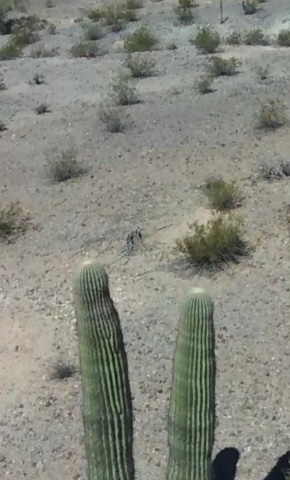
Photo a anthropomorphic frowning cactus appearing to be flipping "the bird"

WHEN SETTLING ISN'T MAKING DO

I was out flying out flying my Parrot Bebop 2 drone yesterday. I used to think it was one hot drone. Then I flew a DJI Phantom 4. Then I saw a demo of the new DJI Mavic Pro drone and took the Phantom back and pre-ordered a Mavic. Which is why I was out flying. I fly drones, not for the flying so much. That's scary. Drones are expensive. I've lost one and crashed several. I fly drones for the photos. The DJI camera gimbal and cameras are much better than what my Bebop 2 has.

But the Mavic Pro isn't likely to arrive for a while. So Bebop and me were out in the Arizona desert west of Phoenix flying and taking pictures. At the very end, packed up and about to drive off, I looked to the right and there it was: a frowning cactus. A few days from Halloween sighting it was timely. It made me think of a Jack-o-Lantern, this Jack-o-Cactus.

Desert photo of scrub, distant mountains and blue sky

Photos other drone pilots post on social media show wondrous things: cathedrals and estates, lush green or craggy snow covered mountains, cruise ships and barges on the sea or rivers, basically a whole lot of amazing places. Around these parts, in the slice of Arizona I call home, all there is is scrub and cactus.

But finding and photographing Jack-o-Cactus made me think that since I got it I should use it.

OUTRO

I wish my Mavic Pro would get here already. It's 4K camera would have taken a much sharper Jack photo. Oh well. Soon. Soon.

My drones (clockwise from top left) Parrot Bebop 2, DJI Phantom 4 and DJI Mavic Pro


Saturday, March 5, 2016

Hey Aviator

PROLOGUE

I'm an aviator. Ok, not really. But I do wear glasses and own a drone quadcopter. The point is I drive something that flies.

Photo of Bebop 2 drone in flight next to a saguaro cactus

HOW LOW CAN YOU GO?

For as long as I can remember I've wanted to _______. But I have a short attention span. It doesn't help I'm attracted to shiny objects. So along the way of my life I've half started a lot of things. But now that I'm an OldPa (a term I remember from an old Lionel Barrymore as grandfather movie) I have a little more disposable income.

So the other day I used some to buy a Parrot Bebop 2 drone. I needed one to respond to an RFP (Request For Proposal). Now that I've responded I have a cool red toy to play with.

Speaking of play, I like to have fun while learning. One way I have tons-o-fun learning is by participating in EdCamps. In a nutshell they're gatherings of teachers where everyone is a genius. I've lost count of how many I've participated in. Anyway, at one of them I noticed how learning can be influenced by environment. I was in a first grade classroom. Not only was everything small, like models I glued together as a boy, most things in the room were scaled down, maybe 3:1. I had expected that.

What I hadn't expected was how low things on the wall were. I'm 6 feet and 5 inches tall. I had to look down at learning aids placed on the walls. Something a six year old looked straight into I had to peer down at. This has AHA! moment kick-started my thinking on learning environments.

THE TOPS OF THINGS

When I spun up the props on my Bebop and got it about three metres in the air I saw a whole new world. Tall as I am I mostly look down at things. Of course I look up at stuff too. But being a creature of habit I tend to not really notice the usual stuff around me. Taking a look at my surroundings from higher up than usual really opened my eyes. Cliche though it may be to say I saw a whole new world it's true.

Photo of the top of a saguaro cactus
RETRACING OLD STEPS

Cactus tops, tree tops, house tops, my bald head are all things the drone and me have captured. I don't expect the novelty to wear off for a while.

In 1977 I entered active duty with the US Navy. I did a lot of traveling over the next six years. One of my more memorable trips was driving my then new Toyota Celica from Corry Station near Pensacola, Florida to my boyhood home in California. The 2209 mile trip took me around 44 hours. I remember bits and pieces of sights along the way. What I remember most though was how big and diverse the southern United States is.

In seven days I start driving from my home in Arizona to a conference in Orlando, Florida. I'll be in my new Honda CR-V. I expect to make a lot of stops along the way. I'm looking forward at what the drone's view reveals.

EPILOGUE

What the drone really does is expand my view just a little bit. My eyes are almost 40 years older than they were in '77. It occurred to me just now how Google Earth lets me look down. The drone makes it more personal, so much more up close. I think that's what an aviator might feel flying through the air. I'm not a passenger peering out a window at the world going by. I'm choosing the path and experience what's coming up.


Tuesday, February 23, 2016

Conf it up

INTRO

What do you do when the concurrent conference session you were really interested in falls flat?

THE LEARNER IN THE MIRROR

I've done it. I'm in a conference session whose title and description really resonated with me. But then a little into it I catch myself browsing the web on my mobile device because the actual presentation isn't all that interesting.

Image of distracted listeners

Over the past 12 months I've gone to a dozen or so conferences. Most were EdCamps; the others were sponsored by professional development organizations.

As a presenter it stings when I don't connect with the people in the room. Heads go down and it's plain they're doing something else. Mea culpa. Reflecting on this on the long drive home from EdCampVentura Sunday I wondered how a presentation might play out if it was more conversational. That's where the root of conference comes from: conversations among people brought together by similar interests.

OUTRO

When a presenter asks their audience to put their mobile devices away are they doing it to avoid disruption? Or might they be saying, "What I have to share isn't all that interesting." Maybe an appropriate response is following that basic tenet of EdCamp: Vote with your feet.


Tuesday, February 9, 2016

An Old Dude Gets Whyze

INTRO

In my personal life rarely do I have a plan.

GIVING UP CONTROL MADE ALL THE DIFFERENCE UNTIL IT DIDN'T

A basic tenet of EdCamp is to vote with your feet. Not getting what you came for? Vote with your feet: Let them take you where you might.

Almost 40 years ago I gave up control of my life for six years. At 20 I enlisted in the US military. In the Navy to be precise. I made choices, sure. But for the most part others made the decisions. Except they were really my choices. Confused? So was I. At least until I read a blog post by @davidtedu on a writing technique known as The Three Whys. The way I figure it asking why three times takes one deeper into a subject. This allows one to glean insights that might have been missed during a more conventional process of analysis.

Why did I join the Navy? To have an adventure. To have a chance at living a life beyond the commute here and there existence I'd known for far too long. Why did I want adventure? Because I felt my life to that point resembled a connect-the-dots puzzle where predefined forms reveal themselves after a period of focused effort. The point is the forms were there all the time. It was live by the numbers 28-29-30 and there you are hello Mr. Easter Bunny. Why do I have a problem with numbers? Because life isn't about counting. Life is more about formulating. And there I got brought up short. Because I don't like to plan. If I really believe in formulating, in thinking deep thoughts and applying, them isn't that planning, which I have mentioned I'm not a big fan of?

AN IDYLLIC YEAR LIVING IN A JUNGLE

Diego Garcia. I spent one of the best years of my life there. Located a little off the equator in the Indian Ocean it's a coral atoll and jungle. The thing about jungles is they smell. Jungles smell bad. It's because jungles are in continual renewal. Old stuff falls to the jungle floor where decomposes. It feeds new life. I had to travel something like 11,000 miles from home to learn that lesson.

I got there after a week riding a C-141 transport plane all the way from Norton AFB (Air Force Base), to Travis AFB, to Hickam AFB, to Anderson AFB, to Clark AFB, to.. Trust me on this point: It took a whole lot of tos to get me where I wanted to be.

Collage of images
Which brings me back to choices. Diego Garcia in 1978 was isolated duty. I volunteered to go there so the Navy obliged and sent me. I learned that I could usually get what I wanted by asking for stuff few wanted. It wasn't a plan. It was a formula.

UP UP AND HEY

I've voted with my feet twice in the last couple weeks. At Design Camp San Diego and EdCampPerris I listened for a time then got up and moved on. What got me moving was a static message, a conversation where one person was doing most of the talking. I know this as teaching. What I'm much more into these days is learning. It's like traveling by air. You can get there slowly by balloon. To go the distance, to make the big leaps, takes oomph, the sort of thing a rocket is good for. The great thing about EdCamp are conversations, where everyone speaks up and shares. It's a kind of design thinking. Everyone speaks up. Different things resonate with different people. Bonds of empathy bring people together for deeper collaboration.

OUTRO

So I asked why a few times and I got whyze. With this whyzdom came the realization that I don't much like being told how something works. I'd much rather listen to a multitude of others share how they think something works and then try it on for size so I can figure out how it works. Thank you David for why assist.


Thursday, January 7, 2016

Learning is motion

INTRO

Initial meetings with clients can be illuminating.

LEARNING ENABLES HEARTS AND MINDS TO GET MOVING

The other day I met with a new client. Their team and I are in the "getting to know you" stage. They showed me a number of slides with data on how many courses were in production, how many were live on their LMS and how many courses were taken by their employees.

Sketch of a human body showing its heart and brain

When I asked about results, what we refer to in the business as return on investment, they drew a blank. Sadly, this is typical. Their data tell a story about butts-in-seats: developing and completing training. But learning is so much more than that.

Don Wettrick teaches a course on innovation at his high school in Indiana. In a Periscope video this morning he talked about how he's considering moving away from traditional grading to PASS/FAIL.

Reflecting on his thoughts I got to thinking that the methods my client and Don use to assess learning misses on efficacy. How well did they achieve their planned result?

One (among many) things I've learned after two years of professional development (PD) alongside K-12 teachers is that mistakes matter. They're a significant part of the learning process. My client, tracking the data they do, don't have visibility on the number of mistakes their organization is making. They don't know if the training they've developed has moved the organization towards its planned result.

OUTRO

I would suggest to Don that grades are important. PASS/FAIL doesn't capture the mistakes learners make along the way. I don't believe grades are a carrot to entice learners to do better for the sake of a higher grade. In Don's Pure Genius he writes how learners say what they're going to do, how much their ultimate work will be worth and then assess along the way and at the end. I believe learning is much more than butts-in-seats. It's about enabling learners to get their hearts and minds in motion doing stuff. Honor the mistakes learners make along the way. Keep the grades.


Monday, December 28, 2015

Wanted Moster

INTRO

I used to be a Hagar the Horrible fanboy. The Dik Browne strip was a hoot and helped me get my day started right. One of my fav strips was where a bartender asks Hagar what he wants. His reply is something I cherish to this day.

WHAT DO I WANT? WHAT DOES ANY VIKING WANT?

Today's #ds106 daily create challenge was to produce a wanted poster.

Screen capture of a Plotagon animation

To get some ideas I googled "wanted poster". An animated poster of Have You Seen This Wizard caught my eye right away. So that's what I decided to make.

OUTRO

I love using my iPad to ideate and prototype. The daily create challenge helps me open up my creative mindset.


Saturday, December 26, 2015

Pains of Glass

INTRO

I spent most of the morning after Christmas looking out my back window and sketching. My mind, free to wander and wonder, eventually coalesced around a pane of glass

INTO THE AIR WE EVENTUALLY THRUST OURSELVES

I used to make a mean paper airplane. It was fun experimenting with folds and tossing them into the air. Some flew mostly straight. Other planes flew erratic paths in the air.

Sketch showing the launch of a paper airplane into the sky
Somewhere, sometime, I remember someone telling me there would come a time when I would have to put aside my childish things. So at some point in my life I did.

Now, many years later I find myself wondering, is there a difference between childish and childlike? As usual when my mind drifts too far afield I ask Mrs for her perspective. What usually happens is while she's sharing I either have a sudden AHA! moment of crystal clear insight or my thoughts go off on an unexpected tangent.

Today it was a sudden insight that brought understanding. Childish suggests something having to do with one's maturity. Caught with my hand in the cookie jar do I deny it's my hand or do I ask, "Want a cookie too?" Childlike, on the other hand, speaks to innocence and wonder.

OUTRO

It's sometimes painful when I look back and recollect. What might have been, if.. I used to think they were cognitive excursions of the wasteful kind. The past is immutable, right? But of course they're not wasted. Reflections can lead to the old seen in new ways and to new directions.

Which brings me to my granddaughter Carly. We light up when we see each other. I've mostly given up sharing things I know with her. We both get more out of our time together when I experience what she shares with me. I like being childlike alongside her. Problems I'm working on seem smaller when I see them as I think Carly might. No pane, no gain.


Sunday, October 25, 2015

Where The Teachers Are

INTRO

I spent Saturday October 24 with a roomful of ELA (English Language Art) teachers at the Arizona K12 Center. We learned about educational technology tools, including how to leverage them to support teaching to Arizona’s college and career ready standards. Disclosure: I’m not a teacher. I do instructional design.

IMPROVISATIONAL PD: FAILING TO GET IT RIGHT

Me not being a teacher is a good thing. I don’t know enough to keep quiet when something was introduced during the workshop. It’s all new to me. Except that it’s not. I learn a lot about K-12 strategies and educational technology at the EdCamps I participate in. Through some applied improvisation later on I figure out how to apply it with the adult learners I support.

I get asked sometimes why participate in so many EdCamps? I think I’m up to 30 so far: EdCamps in Texas, Arizona, California and Washington, DC. It’s because I like the improv. Hearing about something cool I want to try it right away, or as soon as possible, before it gets stale. I view doing something that I just learned from teachers as improv because I’m flying without a net. I don’t know what the cues are. Not being a teacher means I’m not sure about context. So I give it a try and add or drop stuff as seems to make sense.

OUT-OF-THE-BOX THINKING INSIDE OF A BREAKOUT EDU BOX

I hear now and then how we instructional designers need to be more innovative and creative. A lot of times the ideas that come back from “How?” involve advanced educational technology. Since EdCamp I prefer simpler more natural and humanistic approaches.

Photo of BREAKOUT EDU box


At CUEROCKSTAR Las VegasI learned about this Breakout EDU thing. The way it works is you get a box. But not just an ordinary box. Noooo. You get one with a sturdy hasp. About that hasp, it’s an electricians lockout hasp. There can be as many as six locks on this hasp.

Sketch of am electricians lockout hasp attached to a box

The teacher, or in my case instructional designer, crafts an engaging story. This is what teacher and author Dave Burgess calls “A Hook”. My name for it, after watching Jack Black in Goosebumps, is “The Twist.” Anyway, the learner or learners, once engaged, work to solve puzzles. The puzzles and their solutions are grounded in what the learner is being taught or trained on.

EVENT WHEN IT DOESN’T WORK IT WORKS OUT

At AZTEA’s P3: Problems, Projects, and Possibilities conference I presented a session on designing interactive presentations. One of the things I demonstrated was the Breakout EDU box. There were “technical difficulties”, however, and I had to do some improvisation to get over the bump.

Here’s how it was supposed to go. First there was the trailer. Then the backstory. Lastly was the vital clue. Anyway, given technical difficulties I had to play all the parts live. I got to feel the learning. It was pretty cool. I have a whole new perspective on how to do it next time. I’ll definitely have some backup stuff, too.

SCORE ANOTHER ONE FOR THE ZOMBIE (LEARNER) APOCALYPSE

One thing I need to work on, what teacher Chris Long calls Self-Development is the BOOS (Butts-Out-Of-Seats).

Tweet

I think, and some research studies suggests, learning efficacy can be deepened when learners are actively engaged and moving around doing learning activities.

THATS WHERE THE TEACHERS ARE

To review, why do I get most of my PD (Professional Development) from EdCamp & CUE? Because that’s where the teachers are.


Tuesday, July 28, 2015

Sit n Get

INTRO

My K-12 experience spanned from 1961 through 1974. My butt polished a lot of chairs in that time.

SIT

I can't recall many times, outside of PE class, where I wasn't sitting down in school. Sure, there were those terrifying moments working problems on the blackboard. But this activity wasn't something a kid looked forward to.

The classrooms I knew had rows of chairs. Desktop collaboration was difficult. Aside from the floor flat surfaces to spread out and collaborate on were few. I cannot recall a time when we used the floor.

Photo of urbie and his granddaughter Carly

@ErikWahl and @KidsDeserveIt if you want to move education forward then your delivery needs to get students' bodies moving.

GET

I design learning experiences for adults. In the almost two years that I've been participating in EdCamp I have learned many ways to teach kids. I have been able to use some of these techniques and strategies and tools with the learners I support. The best of them involve movement.

Devices and technology give students reach: to information and each other. The information stores, libraries, that I encountered in the 1960s were places to borrow books. The Internet of the day, card catalogues, were slow and cumbersome and in the end useful only insofar as the library was able to keep the resource: book, periodical, or map. Accessing the resource required that I go to the library. Today the information comes to students through browsers and apps.

Students need to be set in motion. In a Twitter chat some time ago I heard about Heutagogy. In a nutshell I think its about going after learning. Students, whether adults or children know what they need. It's arguable that maybe adults have a more definite idea of their needs than children. I'm not so sure.

OUTRO

If we're serious about growing flexible, curious, and creative people we have to set them free to go after what interests them. It's our job as educators to design learning experiences that facilitate that chase. Set our students free. My granddaughter Carly is counting on you.


Friday, May 29, 2015

EdCampUSA Reflections

PROLOGUE

"When the student is ready the teacher will appear." -- Buddhist Proverb?

EdCampUSA

Out of focus photo of several teachers and a laptop

Friday May 29, 2015 saw me keeping company with educators at EdCampUSA in Washington, DC. It was quite a the learning experience. My PLN (Personal Learning Network) grew a few sizes whilst I listened and shared.

REFLECTIONS

I'm going to be thinking about the stuff I learned today. Chief among these includes wearables in education, student voice, and caring enough to figure it out. Not for the first time something occurred to me along the way. Some of what I heard wasn't new. Maybe it was deja vu? Or perhaps I was rehearing something I had heard before and set aside. I can't say for sure. But engaging with peers in conversation and chiming up when I had a mind to made for an exciting time.

EPILOGUE

Brad Pitt, in World War Z, said something to the effect of, "Movement is survival." I think he said it. Any, I think of learning in a similar way. I have to put myself out there where others are. Deja vu or new doesn't really make much difference. When the student is ready learning happens and stuff begins to make sense.


Wednesday, April 15, 2015

Social Earning

PROLOGUE

Good news bad news: learning in collaboration with others via social media can be amazing when learners(and their organizations) engage.

SOCIAL

Learning in the company of others offers learners a significant benefit. Individually they learn from gaining and applying their own knowledge. In groups learners benefit from insights triggered by others sharing their perspectives.

A traditional classroom's capacity may constrain group learning. Environmental issues might hinder social learning as well.

Photo split horizontally with a toddler above and cactus below

EARNING

Learning via social media removes some of the constraints. One, with walls gone you can share knowledge with as many others as you can network with. You can leverage technology to share perspectives across a variety of media: writing, videos, podcasts to name a few.

To benefit from social media learners have to invest themselves in it. Thinking about learning as earnings they have to work at it.

Social media can be a thorny issue for some organizations. Some I have produced learning experiences for have strict policies in place on how social media can be used. Others may prohibit it completely. There are cultural constraints as well. Things people share online via social media is visible. It takes a lot of trust for this exchange to happen.

EPILOGUE

Trust is the currency of learning with social media. When the trust is there learners are motivated to share. My job is designing training that leverages story, what some might call case studies, to hook learners interests and empathy. I keep advocating for it, designing it in where I can. We're getting there.


Tuesday, April 14, 2015

Expeditionary Mettle

PROLOGUE

"There's an old man sitting next to me.." -- Billy Joel -- Piano Man

EXPEDITIONARY

Why I teach.. My response to AprilBlogaDay Day 14.

Once upon a time, "When I wore a younger man's clothes," a US Navy uniform actually, I went on an expedition. I travelled far from home and all I knew. It's why I teach.

Graphic of a US Navy Expeditionary Medal

METTLE

I'm a little older now. I'm still expeditioning. These days my voyages are mostly over the American Southwest. At the helm of my Honda Pilot I travel far and wide to unconferences and conferences. I meet and learn from some amazing educators. Mettle. It's why I teach.

A graphic showing several costumed teachers at EdCampATX

EPILOGUE

Why do I teach? I teach to learn. Those years I taught multimedia production, animation, and programming I learned from my students. I benefitted greatly from their questions and perspectives.

Today, as I design transformational learning experiences, I continue to learn. It's why I teach.


Saturday, April 11, 2015

Hiddenest Selfs

PROLOGUE

"Our own truths can be the hiddenest of all." -- Me

HIDDENEST

Day 11, AprilBlogaDay: It dawned on me a moment ago that it's a challenge. We're being dared to keep at it ever day, all month long. That's 30 days of month days.

Today's suggested topic: What are you reading professionally or personally, and why? My holistic take is everything I read has application in my craft and is fun to one degree or another.

I am always on the prowl for instructional strategies. The other day my gaze fell upon this gem: Simpson's Grammar.

Sketch of mangled grammar

I tend to read during quiet times. It's been a while since I read with other readers nearby for more than a few minutes.

SELFS

I start lots of books. Mostly they're on my iPad's Kindle app. I like science fiction. Some cool ideas have come from the genre.

Screen capture showing Kindle book covers

Many books come recommended by people I know from EdCamps or Twitter chats. The thing they have in common include making the learning visible, doing what it takes to engage curiosity, and setting high and achievable expectations.

A couple-three years ago my professional self noticed many learners were disenchanted by what and how they were learning. I'm mostly talking about the training we get through our employers.

The people I interviewed gave a lot of reasons why it turned them off. It all got down to b-o-r-I-n-g. But not in the dull mind-numbing sense that probably popped into your mind first. The learning experiences they were being subjected to were superficial: Designers didn't develop learning that grabbed attention, that drilled down into what people wanted and needed to really learn and apply to improve their job performance.

EPILOGUE

Maybe we do a better job going our own way, seeking out learning that clicks for us. Or not. One thing I learned a while back that really touched me deeply: When Mrs needs help I should jump. She needs help putting the new leaf blower together. What makes you jump?


Sunday, April 5, 2015

Cache Shoes

PROLOGUE

I spend a lot of time in the country. Silos dot this landscape. Though I have no direct knowledge of their operation, the sort of hard-won experience earned through sweat and toil, I'm pretty sure they're used to store stuff like grain and whatnot. When I thought about what to blog on AprilBlogADay Day 5 silos immediately popped into my head.

illustration of several sets of silos
CACHE
Silos are full of stuff. What stuff? No idea. That is to say, you have to be in the silo to know what's inside.
 
When I think about ways to move education forwards the first constraint I come up with is silos. I do instructional design. I've produced learning experiences for learners in academia, in the corporate realm (financial services and high technology manufacturing), K-12, and government. I've been able to glimpse inside some of the silos, K-12s mostly; however my deepest dive has been in the corporate realm. There's some cool stuff in there. It makes me wonder what caches of know-how are in the silos of other educators.

Through my participation in EdCamp unconferences and events put on by CUE and TCEA I've been able to skim the surface of K-12 teaching and learning strategies. There's some awesome stuff there, by the way. I like the learning and reflecting and, sometimes, figuring out ways of applying it to my craft.
 
SHOES
 
One of the major topics of discussion in corporate L&D (Learning and Development) centers on engagement. How do we, as designers, create training that engages learners so that the messages we try to impart stick more easily. But, and this is sure to upset some, the strategies and tools available to us haven't changed all that much over the years. I dread the NEXT (screen) button in elearing for example. Ditto with compliance courses that require learners to sit in front of a computer for a specific amount of time to be able to get credit.
 
EdCamp has taught me that there are things we can do to get adult learners moving and making. But to make real progress we, educators of all stripes, have to open up our silos to other educators. How's that expression go: Walk a mile in my shoes or something like that.
 
EPILOGUE
 
Sometimes when I suggest a learning strategy to a customer that's a little out there, teaching like a pirate for example, I get raised eyebrows. I immediately say that they need to suspend their disbelief for a moment. Sometimes a leap of faith is required to make real progress. I know the stuff in your silo is the result of years of sweat and toil. All I'm saying is engage educators serving learners other than yours and share what you know.


Saturday, April 4, 2015

Carts is Parts

PROLOGUE

Today is day four of the #AprilBlogAday challenge on Twitter. The suggested topic is humanity -- describe a time when you connected with students in a classroom. Here's my tale.

CARTS

My first encounter with Joe Zombie wasn't during my tenure as an Intel basic fab skills training (BFST) program manager in the late 1990s. I'm certain there were many other instances before then.

Students are people. They aren't objects. They have needs. They have memories. They can move at will. You want them moving and making their learning visible.

Photo of parked grocery shopping carts

Students aren't shopping carts. Let's get that out there. Empty vessels? Nope. Parking students in a learning space and teaching them leads mostly to boredom and disengagement. It's sleepy-time for the mind.

One of the courses in the BFST program concerned the fab's (Intel Pentium factory running P858 process) loss control system (LCS). The Level One evaluations were bad. As I recollect it, comments included stuff like "Snoozeville.", "How am I going to ever remember this?", and my personal fav "Death by PowerPoint."

Yes, it was one of those lessons where an instructor projects slides on a screen and reads them to you for two hours. Just in case you miss something you have a two-up handout with the slides that are verbatim what the instructor is displaying and talking about. A Joe Zombie moment for sure. Oh, and the students' supervisors let me know they weren't happy either.

PARTS

I asked the engineer who designed the course what she wanted the workers to do with the LCS. They needed to "Be able to record losses and near misses so we can improve factory yields." she said.

A couple years earlier I'd completed an Accelerated Learning workshop. The strategies I learned were similar to what you'd learn reading Teach Like a Pirate by Dave Burgess. Thus armed with creative teaching and learning strategies I went out on a limb and got crazy.

Pin-the-tail-on-the-donkey: Remember that game? Hopefully you got invited to parties where you got a chance to make a fool of yourself by pinning a tail where it didn't belong. That was my activity. Students entering the classroom saw wafers (what integrated circuits like Pentiums are made on) velcroed to a fabric covered wall. They listened to an experienced fab worker describe the LCS. This lasted about five minutes. A few minutes more for questions followed.

Students were then handed out a sheet of paper simulating the LCS. They were tasked with taking a wafer off the wall. Turning it over they saw a blurb describing an actual wafer loss or near-miss. They then filled out the sheet based on their understanding of the situation.

I left Intel in 1999. I don't know if my LCS activity survives. I would guess not, given how effective Intel is with continuous improvement. For the time the LCS learning experience was part of BFST it made workers happy and able to use the system in the fab. Supervisors were happy because yields improved as problems were identified and fixed. I was ecstatic because it was the first time I used an authentic learning strategy that students could identify with, leave the safety of their chairs, and move and make. It moved me, too.

EPILOGUE

They listened. They asked. They moved and made. These are three essential parts of designing learning experiences. I continue to use these in the learning experiences i produce today.


Friday, April 3, 2015

Tool Time

PROLOGUE

I'm on my fifth career. I launched career number two, electronics engineering, whilst serving in the US Navy in the 1970s. It had its own language and tools. For something like 16 years in the military and after, I was deft keeping complex systems up and running. I have quite a few sea stories from that age that I share from time to time.

Photo of an old toolbox and its contents

TOOL

Solder suckers, screwdrivers, and dice were some of the tools I had in that long ago toolbox. These days my toolbox looks a lot different. It surprises me how much my work continues to involve technology.

I love learning about and using new tools. One of them is this blog. Sharing thoughts about my craft serves several purposes. I get to practice and improve my writing skills. Blogging is deep journaling; it's cool how it helps me reflect. It also helps me connect with other educators.

A few hours ago I heard about #AprilBlogAday on Twitter. So yea! More practice time.

TIME

I'm at work nine hours a day. Family and personal time averages five to six hours per day. Rest periods eat up most of the remaining hours. I have time to blog. So why don't I blog more and regularly?

I have stuff to share. I think I have too much actually. The problem, if I can all it that, is they're incomplete thoughts. While I am intensely focused in my work my attention is a little more diffuse on other stuff. One thing that occupies more and more of my free time is the Joe Zombie effect. That's what I call learner disengagement, the result of ineffectual teaching and learning strategies.

EPILOGUE

I'm not nearly done with my research. Should I blog as I go or wait until I have a more complete picture? Maybe I'll have a clear idea by the end of the month.


Sunday, March 15, 2015

The Ebb and Flow of Kick-Starting Creativity

PROLOGUE

Wow! Just wow!

Photograph of Urbie Delgado

EBB

Today I participated in the Digital Storyteller: Creative Bootcamp at Gangplank in Chandler, Arizona. Whilst I've spun a few digital stories in my day I wanted to learn this new Drafting and Crafting process. While similar in some ways to Design Thinking it differs in some significant ways.

How do I craft thee? Let me count the ways.

  1. Plan
  2. Checklist
  3. Brainstorming
  4. Drafting
  5. Crafting
  6. Measures

FLOW

The drafting and crafting process I learned today begins with a statement that says this is where I am. Whether brainstorming, drafting, or crafting each ends with this is what I made. It's apparent right away what happened. In the bootcamp session, facilitated by Ita Udo-Ema, there is also a timer set to count down from 45 minutes. Before and after each round there is a question: What well did you do? This is followed up with advice. Afterwards there is feedback.

KICK-STARTING

I tend to work digitally throughout my workflow. I liked filling out a checklist where I noted what I would do, what I did, and what I would do next. I did use apps. After the brainstorming I had this stack of stickies. I scanned these using 3M's Post-It Plus for archiving in Evernote.

I was reminded by how similar brainstorm, drafting, and crafting is to Design Thinking's define, ideate, and prototype.

Photograph of a stack of ideas on sticky notes

CREATIVITY

An EdCampAwesome session encouraged me to give video blogging a try. After each iteration I recorded a few observations. They're viewable at:

  1. Brainstorming
  2. Drafting
  3. Crafting

There were several times during the process where I felt energized. These coincided with feelings of being on the edge of my seat. It was fun. If this is creativity then I want more.

EPILOGUE

Inspired by Saturday's #WebComicChat I planned to create a comic of my own. I think I accomplished my goal. At the end of the bootcamp i noted two feelings. One, that my cartoon character looked a little like a sketchnote character. I could feel something well up in me at this point. This is the second feeling: What makes me think I can draw? The fact is, I can.

Sketch of a cartoon character considering a crossroads

This takeaway was straight out of what I learned through EdCamp. Making really drives learning home. It makes learning visible.


Monday, February 23, 2015

Desktops, Tabletops, and Tablet-Ops

PROLOGUE

Blackboards and college ruled notebook paper: Back when I started school these were the media teachers and students wrote on. Period. Mediums have, of course, evolved since then. During last Saturday's EdCampAwesome (session notes) in Royse City, Texas I had a glimpse on how much has changed.

DESKTOPS

One of the EdCampAwesome sessions I participated in was Moving to Learn/Kinesthetic Learning facilitatedby Cheri Froehling.

Sketchnotes of EdCampAwesome session on Kinesthetics in learning
One of the images she shared was of a young girl smiling over a sketch she had drawn, in marker, on the top of her desk. My immediate thought was, "Wow! Wonder how many erasers she had to clean after school?" Only of course, she didn't have to clean anything except her own dry erase markings on the desk. Said Cheri: "Naughty is engaging. Doing something you're not supposed to do in class helps learning stick more easily." Cheri and many of the teachers in the room with me had some great ideas, out-of-the-box for me, on how to engage body and mind in learning.

TABLETOPS

Which brings me to the adult learning environment I design for. Dry erase boards are everywhere in this space. Flip charts are common as well, providing places for notes to be written; hanging them on walls to be referred to later is a kind of group memory.

I wonder what might happen if the next training I develop has learners take notes or collaboratively work out problems on their tabletops? I haven't seen this done before, at least not with the encouragement of an instructor and the participation of others. I'm a big fan of the maker movement. Working out problems on something you think you shouldn't be writing on might make for an interesting learning activity.

In the adult learning spaces I design for learners working out problems collaboratively on their desktops might be a stretch. Maybe not. I don't know for sure but it's something to think about, talk about, and play with.

TABLET-OPS

Which brings me to a project I'm working on now. It involves design thinking and rapid prototyping. What would adult learning look like if learners worked out problems collaboratively using the mobile devices, smartphones and tablets, many use every day? I've learned tons from the teachers I meet at EdCamps I've been to in Texas, Arizona, and California. I'll be sharing what I've learned during my Mobile Rapid Prototyping Through AppSmashing concurrent session at the eLearning Guild's mLearn Conference in Austin, Texas this June.

EPILOGUE

The other EdCampAwesome session I attended was Flipping PD with Don Jacobs. It involved doing brief video clips, micro podcasts I guess, to share know-how with peers. So I think I'll give this a try soon. My weekend was EdCampAwesome.


Saturday, February 21, 2015

High-Speed Reflections

INTRO

Mrs and me have been married going on 24 years. One would think life partners would know everything there is to know about each other in that time. In my case, you'd be mistaken.

Photograph of graffiti on a wall with a windmill in the background

HIGH-SPEED

Somewhere near Weatherford, Texas driving along Interstate 30 at 75 mph something Mrs said as we were leaving Abilene struck a chord. I'd mentioned this cool job (for her) that I saw in an email. There was a pause as she absorbed the information. She told me how she would perform the tasks required by the position.

REFLECTIONS

My initial thoughts were that she was jumping the gun a bit. She should be thinking of how she might apply for it. Later on, in the just before dawn darkness, I realized that this must be how Mrs orders thoughts in her mind. Many of the conversations Mrs and I have had over the years started like this. It's in my nature to start doing early. Mrs likes to think about doing before she commits to action.

OUTRO

So, where does this leave me? I think it offers me the chance to think a little deeper about the learning experiences I design. Typically they begin with a story to set the stage. I learned some time ago about how learning styles are a myth. But do people have doing styles? Do we have habits that frame how we respond to stories, case studies, and simulations?


Friday, February 13, 2015

Ed-Pa-Camp

PROLOGUE

I'm a John Wayne fan. Maybe it's because he looks like papa? There's this line he has In Harms Way where The Duke says, "She's a good ship headed in harms way." It's an allusion to a U.S. Navy warship headed out to sea during the opening days following Pearl Harbor. Thinking about raising children and helping them along the way so they're successful in school reminded me of the harm we can do to our children if we don't get it right.

ED

My youngest is about grown. There is so much about her that's new. It scary, in a very good way, when I marvel at what she will do in her life. Though Mrs. and I raised her from a seed there is much about her that is unknown. I think this is wonderful. Realizing this while my daugther and I chatted over breakfast a few minutes ago reminded me there is always at least one more thing that can be learned.

PA

I was lucky to be out of work here and there during the first few years of parenthood. I got to know each of my three girls in a very fundamental way. It's a wonder that I can still see in each one snippets of what they were like when they were little. Along the way being parents Mrs and I made difficult choices regarding where to live, who stays home with the kids because child care can be so expensive, and so on. You've probably made similar decisions, too. Anyway, reflecting on raising my daughters reminded me there is always room for improvement.

CAMP

A few days ago someone asked for my perspective on how the curriculum night experience could be improved. Curriculum night is a rite of passage sort of event in Arizona (maybe everywhere) where parents meet their children's teachers a week or two after the new school year has begun. Topics of discussion include school and teacher policies along with a brief overview of what teachers will teach and students will learn. I replied, foolishly it occurred to me later, that I'd blog about it the next day. Only I didn't. I reflected on what I might say for most of a week.

I thought about the many constraints all those involved in the process face: children, teachers, parents. Time and distance were my main concerns. I usually worked far from home. With curriculum night happening on one night for all grades, classes, and students you can imagine what just getting there in front of a teacher requires.

A year and a half ago I encountered the EdCamp model of professional development courtesy of EdCampWestTexas. The unconference experience, where there is no preset agenda and participants make it up based on the interests of participants and know-how of those in the room, has had a profound effect on my personal and professional life. The EdCamps I participated in were always held on Saturdays; most were on site at a school; several were online via a Google Hangout.

So, after much reflection I think shifting curriculum night from its current model, where it's held for several hours after school on a weeknight, to an EdCamp model is worth a try. Making it an all day, say over six hours, on a Saturday might make it easier for parents to attend. Curriculum night could include all it had before plus a crash-immersion in what teaching strategies teachers use. This is a big deal. Until I started going to EdCamp I had no idea what teaching and learning was really like in my kids' schools.

EPILOGUE

So there it is Jeremy. Remake curriculum night so it looks more like an EdCamp.Take your time with it. Open it up so it's about more than policy. Curriculum night is not something you want to scale: Where, like Christmas, it happens over the span of two or three hours one night.

It'd be cool if the children could come, too. It's in everyone's best interest that we get this education thing right.