Showing posts with label educational technology. Show all posts

Sunday, October 23, 2016

Fuzzy Thinking

INTRO
What was lost, found, I looked up and there it was in the distance, about 30 meters away. Not my missing phone case, it was in my car the whole time. This..
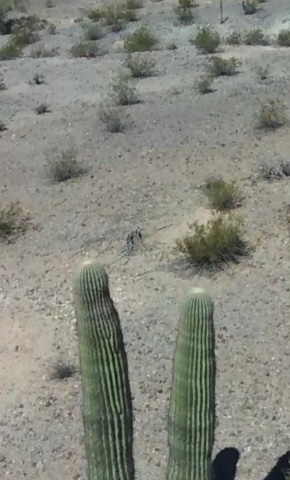
Photo a anthropomorphic frowning cactus appearing to be flipping "the bird"

WHEN SETTLING ISN'T MAKING DO

I was out flying out flying my Parrot Bebop 2 drone yesterday. I used to think it was one hot drone. Then I flew a DJI Phantom 4. Then I saw a demo of the new DJI Mavic Pro drone and took the Phantom back and pre-ordered a Mavic. Which is why I was out flying. I fly drones, not for the flying so much. That's scary. Drones are expensive. I've lost one and crashed several. I fly drones for the photos. The DJI camera gimbal and cameras are much better than what my Bebop 2 has.

But the Mavic Pro isn't likely to arrive for a while. So Bebop and me were out in the Arizona desert west of Phoenix flying and taking pictures. At the very end, packed up and about to drive off, I looked to the right and there it was: a frowning cactus. A few days from Halloween sighting it was timely. It made me think of a Jack-o-Lantern, this Jack-o-Cactus.

Desert photo of scrub, distant mountains and blue sky

Photos other drone pilots post on social media show wondrous things: cathedrals and estates, lush green or craggy snow covered mountains, cruise ships and barges on the sea or rivers, basically a whole lot of amazing places. Around these parts, in the slice of Arizona I call home, all there is is scrub and cactus.

But finding and photographing Jack-o-Cactus made me think that since I got it I should use it.

OUTRO

I wish my Mavic Pro would get here already. It's 4K camera would have taken a much sharper Jack photo. Oh well. Soon. Soon.

My drones (clockwise from top left) Parrot Bebop 2, DJI Phantom 4 and DJI Mavic Pro


Saturday, March 12, 2016

5 a.m.

INTRO

It's 5 a.m. on a Saturday. I'm on a path that I'm not sure where it goes.

FADED PHOTOGRAPHS OF VIVID MEMORIES THAT MAY NOT HAVE HAPPENED, YET

I'm on my way to #LSCon, the Learning Solutions Conference, produced by the eLearning Guild. But that's not what this post is about. I'm on my way to Orlando, Florida where the conference is held. To get there I have to travel along a path from my distant past.

The end of 1977 found me at Corry Station learning the finer points of being a technical sailor in the US Navy. Corry Station, in ancient times, was a naval air station. I have a vivid memory walking across the old runway apron and tripping over an old aircraft tie-down cleat. It was set, recessed, into the concrete, a small loop of rusted iron. At least that's how I remember it. I think I took a photo of it. If I did I lost it. It isn't in my Flickr, one of the apps I use to record photos.

Screen capture of a grayed-out Flickr screen

At this very moment I'm in El Paso readying myself for today's travel. I'm connected to the Internet via a 3G Verizon mobile device. In its day it was fast. Today it's like molasses. A few minutes ago I was in Flickr looking for old photos. After about two years of pictures the screen turned gray. The photos are there, on a server somewhere, but not here in front of me to verify my memory.

I hope to travel 600 miles today just like I did yesterday. Except that yesterday I barely made it 400 miles. I kept stopping, for reasons of health and curiosity, to pass some time among memories. I flew my BeBop drone to give me a perspective I didn't have back then. If you follow me on social media expect lots of fisheye views of the ground from 30 metres up the next few days.

OUTRO

In 1977 parts of Interstate 10 hadn't been completed. Today, I hope to find a detour I took around one such unfinished section. Only I'm not 100% sure where it was. One end was at Fort Stockton, Texas. I recall a cattle watering tank and an ancient Ford Aeromotor (a windmill). If I find them, expect a flyover. If I can't find it maybe I'll do a sketch of the vivid memory of something I think I saw 39 years ago for a moment.


Saturday, March 5, 2016

Hey Aviator

PROLOGUE

I'm an aviator. Ok, not really. But I do wear glasses and own a drone quadcopter. The point is I drive something that flies.

Photo of Bebop 2 drone in flight next to a saguaro cactus

HOW LOW CAN YOU GO?

For as long as I can remember I've wanted to _______. But I have a short attention span. It doesn't help I'm attracted to shiny objects. So along the way of my life I've half started a lot of things. But now that I'm an OldPa (a term I remember from an old Lionel Barrymore as grandfather movie) I have a little more disposable income.

So the other day I used some to buy a Parrot Bebop 2 drone. I needed one to respond to an RFP (Request For Proposal). Now that I've responded I have a cool red toy to play with.

Speaking of play, I like to have fun while learning. One way I have tons-o-fun learning is by participating in EdCamps. In a nutshell they're gatherings of teachers where everyone is a genius. I've lost count of how many I've participated in. Anyway, at one of them I noticed how learning can be influenced by environment. I was in a first grade classroom. Not only was everything small, like models I glued together as a boy, most things in the room were scaled down, maybe 3:1. I had expected that.

What I hadn't expected was how low things on the wall were. I'm 6 feet and 5 inches tall. I had to look down at learning aids placed on the walls. Something a six year old looked straight into I had to peer down at. This has AHA! moment kick-started my thinking on learning environments.

THE TOPS OF THINGS

When I spun up the props on my Bebop and got it about three metres in the air I saw a whole new world. Tall as I am I mostly look down at things. Of course I look up at stuff too. But being a creature of habit I tend to not really notice the usual stuff around me. Taking a look at my surroundings from higher up than usual really opened my eyes. Cliche though it may be to say I saw a whole new world it's true.

Photo of the top of a saguaro cactus
RETRACING OLD STEPS

Cactus tops, tree tops, house tops, my bald head are all things the drone and me have captured. I don't expect the novelty to wear off for a while.

In 1977 I entered active duty with the US Navy. I did a lot of traveling over the next six years. One of my more memorable trips was driving my then new Toyota Celica from Corry Station near Pensacola, Florida to my boyhood home in California. The 2209 mile trip took me around 44 hours. I remember bits and pieces of sights along the way. What I remember most though was how big and diverse the southern United States is.

In seven days I start driving from my home in Arizona to a conference in Orlando, Florida. I'll be in my new Honda CR-V. I expect to make a lot of stops along the way. I'm looking forward at what the drone's view reveals.

EPILOGUE

What the drone really does is expand my view just a little bit. My eyes are almost 40 years older than they were in '77. It occurred to me just now how Google Earth lets me look down. The drone makes it more personal, so much more up close. I think that's what an aviator might feel flying through the air. I'm not a passenger peering out a window at the world going by. I'm choosing the path and experience what's coming up.


Thursday, January 7, 2016

Learning is motion

INTRO

Initial meetings with clients can be illuminating.

LEARNING ENABLES HEARTS AND MINDS TO GET MOVING

The other day I met with a new client. Their team and I are in the "getting to know you" stage. They showed me a number of slides with data on how many courses were in production, how many were live on their LMS and how many courses were taken by their employees.

Sketch of a human body showing its heart and brain

When I asked about results, what we refer to in the business as return on investment, they drew a blank. Sadly, this is typical. Their data tell a story about butts-in-seats: developing and completing training. But learning is so much more than that.

Don Wettrick teaches a course on innovation at his high school in Indiana. In a Periscope video this morning he talked about how he's considering moving away from traditional grading to PASS/FAIL.

Reflecting on his thoughts I got to thinking that the methods my client and Don use to assess learning misses on efficacy. How well did they achieve their planned result?

One (among many) things I've learned after two years of professional development (PD) alongside K-12 teachers is that mistakes matter. They're a significant part of the learning process. My client, tracking the data they do, don't have visibility on the number of mistakes their organization is making. They don't know if the training they've developed has moved the organization towards its planned result.

OUTRO

I would suggest to Don that grades are important. PASS/FAIL doesn't capture the mistakes learners make along the way. I don't believe grades are a carrot to entice learners to do better for the sake of a higher grade. In Don's Pure Genius he writes how learners say what they're going to do, how much their ultimate work will be worth and then assess along the way and at the end. I believe learning is much more than butts-in-seats. It's about enabling learners to get their hearts and minds in motion doing stuff. Honor the mistakes learners make along the way. Keep the grades.


Monday, December 28, 2015

Wanted Moster

INTRO

I used to be a Hagar the Horrible fanboy. The Dik Browne strip was a hoot and helped me get my day started right. One of my fav strips was where a bartender asks Hagar what he wants. His reply is something I cherish to this day.

WHAT DO I WANT? WHAT DOES ANY VIKING WANT?

Today's #ds106 daily create challenge was to produce a wanted poster.

Screen capture of a Plotagon animation

To get some ideas I googled "wanted poster". An animated poster of Have You Seen This Wizard caught my eye right away. So that's what I decided to make.

OUTRO

I love using my iPad to ideate and prototype. The daily create challenge helps me open up my creative mindset.


Sunday, October 25, 2015

Where The Teachers Are

INTRO

I spent Saturday October 24 with a roomful of ELA (English Language Art) teachers at the Arizona K12 Center. We learned about educational technology tools, including how to leverage them to support teaching to Arizona’s college and career ready standards. Disclosure: I’m not a teacher. I do instructional design.

IMPROVISATIONAL PD: FAILING TO GET IT RIGHT

Me not being a teacher is a good thing. I don’t know enough to keep quiet when something was introduced during the workshop. It’s all new to me. Except that it’s not. I learn a lot about K-12 strategies and educational technology at the EdCamps I participate in. Through some applied improvisation later on I figure out how to apply it with the adult learners I support.

I get asked sometimes why participate in so many EdCamps? I think I’m up to 30 so far: EdCamps in Texas, Arizona, California and Washington, DC. It’s because I like the improv. Hearing about something cool I want to try it right away, or as soon as possible, before it gets stale. I view doing something that I just learned from teachers as improv because I’m flying without a net. I don’t know what the cues are. Not being a teacher means I’m not sure about context. So I give it a try and add or drop stuff as seems to make sense.

OUT-OF-THE-BOX THINKING INSIDE OF A BREAKOUT EDU BOX

I hear now and then how we instructional designers need to be more innovative and creative. A lot of times the ideas that come back from “How?” involve advanced educational technology. Since EdCamp I prefer simpler more natural and humanistic approaches.

Photo of BREAKOUT EDU box


At CUEROCKSTAR Las VegasI learned about this Breakout EDU thing. The way it works is you get a box. But not just an ordinary box. Noooo. You get one with a sturdy hasp. About that hasp, it’s an electricians lockout hasp. There can be as many as six locks on this hasp.

Sketch of am electricians lockout hasp attached to a box

The teacher, or in my case instructional designer, crafts an engaging story. This is what teacher and author Dave Burgess calls “A Hook”. My name for it, after watching Jack Black in Goosebumps, is “The Twist.” Anyway, the learner or learners, once engaged, work to solve puzzles. The puzzles and their solutions are grounded in what the learner is being taught or trained on.

EVENT WHEN IT DOESN’T WORK IT WORKS OUT

At AZTEA’s P3: Problems, Projects, and Possibilities conference I presented a session on designing interactive presentations. One of the things I demonstrated was the Breakout EDU box. There were “technical difficulties”, however, and I had to do some improvisation to get over the bump.

Here’s how it was supposed to go. First there was the trailer. Then the backstory. Lastly was the vital clue. Anyway, given technical difficulties I had to play all the parts live. I got to feel the learning. It was pretty cool. I have a whole new perspective on how to do it next time. I’ll definitely have some backup stuff, too.

SCORE ANOTHER ONE FOR THE ZOMBIE (LEARNER) APOCALYPSE

One thing I need to work on, what teacher Chris Long calls Self-Development is the BOOS (Butts-Out-Of-Seats).

Tweet

I think, and some research studies suggests, learning efficacy can be deepened when learners are actively engaged and moving around doing learning activities.

THATS WHERE THE TEACHERS ARE

To review, why do I get most of my PD (Professional Development) from EdCamp & CUE? Because that’s where the teachers are.


Tuesday, August 18, 2015

Write This Down

PROLOGUE

“Write this down."

BACKSTORY

A month from now it will be two years that my PD (Professional Development) has taken place primarily through interactions with K-12 educators. I started participating at EdCamp in September 2013. I became a card-carrying member of TCEA (Texas Computer Education Association) around the same time. My learning through CUE conferences and CUERockstar happened this year. It's time and effort well spent.

A few days ago I attended an Explore Teaching session at Rio Salado College. The experience was designed to give pre-teacher students a glimpse of what being a teacher is like. It was quite different from what I expected: the application of pedagogy and technology and engagement. No. It was basic stuff, some of which I had missed during my own K-12 educational experience. Though I had heard that “Being a student doesn’t qualify one to be a teacher." the deeper meaning of the phrase had escaped me until now.

BASICS

My K-12 experience took place in the nineteen sixties and early seventies. I would have liked to have learned about Cornell Notes back then. That’s one cool way of note-taking. I liked learning how to use them as a study-aide too. It’s a more structured way of taking notes but I can see its value.

Beyond learning about note-taking tools I was a little surprised to find that not much else had changed. Teachers still stand at the front of a room pointing and talking. I was a little shocked when the presenter would say, “Write this down.” That was my first aha moment.

ROCKSTAR

The EdCamps and CUE conferences I’ve attended have been dynamic learning experiences. They are heavily focused on educational technology. But the presenters always share how to apply technology to facilitate learning and enable student success. CUERockstar, the most recent K-12 learning experience I completed, was in many ways a capstone where everything came together: creativity, innovation, technology, learning experience. But what about the basics? The teachers I learn from have the basics down. Even the new teachers have student teaching and observation experience.

This was my second aha. Funny to think that it took me almost two years to figure it out. I don’t think I would have gotten it otherwise.

ENGAGEMENT

Since CUERockstar Las Vegas, it ended a couple weeks ago, I’ve tried two things. The first was creating an infographic and using it as a talking point with a subject matter expert (SME). It was amazing. It took my usual design thinking approach to interviewing, something I learned via EdCamp, to a whole new level. The ideas flowed. The SME ended up doing the initial workshop outline for me. This is a big deal because usually I create the outline and the SME reviews and approves it or kicks it back for edits. This saved us a LOT of time.

The other thing I tried was the Breakout Box experience. We, the SME and I, didn’t actually have a box. I explained how it was a box with several locks that needed to be opened and how problems had to be solved to unlock to locks. The SME and I were together for 90 minutes. It was at about the 25 minute mark I mentioned Breakout Box. We hit flow-state a little after.

PROBLEMS

The learning experiences I design are meant to enable learners to be better at solving problems. But what’s a problem? When the SME heard about the Breakout Box the problems all of a sudden seemed to become simpler. They weren’t problems at all. They were puzzles to solve. We could make the workshop a game. I learned from a podcast, I think it was with Jon Corippo, that rigor doesn’t mean harder. It can mean challenging. The SME said it before I did. “How about if we make it so the first activity is easy. They (learners) will have lots of time to solve the puzzle.” Yes. Each iteration of the activity learners have less time to solve the puzzle.

EPILOGUE

A week and a day after CUERockstar Las Vegas ended I earned the Rockstar Badge. Going forwards I have to approach projects using a simpler frame. I can already imagine how to make learning more engaging while consuming fewer resources by getting back to basics. I think I’ll enroll in the teacher program at Rio Salado College. Not to necessarily become a teacher, but to enrich my understanding of how instructional design can teach.


Tuesday, July 28, 2015

Sit n Get

INTRO

My K-12 experience spanned from 1961 through 1974. My butt polished a lot of chairs in that time.

SIT

I can't recall many times, outside of PE class, where I wasn't sitting down in school. Sure, there were those terrifying moments working problems on the blackboard. But this activity wasn't something a kid looked forward to.

The classrooms I knew had rows of chairs. Desktop collaboration was difficult. Aside from the floor flat surfaces to spread out and collaborate on were few. I cannot recall a time when we used the floor.

Photo of urbie and his granddaughter Carly

@ErikWahl and @KidsDeserveIt if you want to move education forward then your delivery needs to get students' bodies moving.

GET

I design learning experiences for adults. In the almost two years that I've been participating in EdCamp I have learned many ways to teach kids. I have been able to use some of these techniques and strategies and tools with the learners I support. The best of them involve movement.

Devices and technology give students reach: to information and each other. The information stores, libraries, that I encountered in the 1960s were places to borrow books. The Internet of the day, card catalogues, were slow and cumbersome and in the end useful only insofar as the library was able to keep the resource: book, periodical, or map. Accessing the resource required that I go to the library. Today the information comes to students through browsers and apps.

Students need to be set in motion. In a Twitter chat some time ago I heard about Heutagogy. In a nutshell I think its about going after learning. Students, whether adults or children know what they need. It's arguable that maybe adults have a more definite idea of their needs than children. I'm not so sure.

OUTRO

If we're serious about growing flexible, curious, and creative people we have to set them free to go after what interests them. It's our job as educators to design learning experiences that facilitate that chase. Set our students free. My granddaughter Carly is counting on you.


Friday, May 29, 2015

EdCampUSA Reflections

PROLOGUE

"When the student is ready the teacher will appear." -- Buddhist Proverb?

EdCampUSA

Out of focus photo of several teachers and a laptop

Friday May 29, 2015 saw me keeping company with educators at EdCampUSA in Washington, DC. It was quite a the learning experience. My PLN (Personal Learning Network) grew a few sizes whilst I listened and shared.

REFLECTIONS

I'm going to be thinking about the stuff I learned today. Chief among these includes wearables in education, student voice, and caring enough to figure it out. Not for the first time something occurred to me along the way. Some of what I heard wasn't new. Maybe it was deja vu? Or perhaps I was rehearing something I had heard before and set aside. I can't say for sure. But engaging with peers in conversation and chiming up when I had a mind to made for an exciting time.

EPILOGUE

Brad Pitt, in World War Z, said something to the effect of, "Movement is survival." I think he said it. Any, I think of learning in a similar way. I have to put myself out there where others are. Deja vu or new doesn't really make much difference. When the student is ready learning happens and stuff begins to make sense.


Thursday, April 16, 2015

Be Long

PROLOGUE

AprilBlogaDay Day 16.. PLC & PLN and why they matter.

Collage of three photos including an irrigation ditch, a bag with the EdCampWestTexas logo, and a man standing next to a space alien totem

BE

Old news if you know me but worth saying again: The know-how and skills I learned during three months of EdCamp in 2013 got me home. Home, Mrs and me agree, is where I need to be.

LONG

From 2010 through early 2014 my job kept me far from home. I'm talking thousands of miles over that-a-way. Eager for new ideas to inform my instructional design craft I researched educational technology from my cubby in New Mexico. Up to that time, this was August 2013, I'd been active in my PLN (Personal Learning Network) on Twitter.

I participated on chats. I heard about stuff. Only it was mostly tried and true stuff. Don't get me wrong. The instructional strategies I heard about were practical, effective, and easy to put into practice with the learners I supported. But I could feel myself sliding slowly into a rut.

That was when I found my first PLC (Personal Learning Community). I'm talking about EdCampWestTexas.

Subtle: the difference between a PLC and a PLN I mean. It's subtle. As I get it a PLN is a gathering of like-minded people located some distance from each other. Social media apps like Facebook and Twitter enable them to come together virtually periodically. Occasionally individual PLN members might meet at an event. But for the most part their interests bring them together online for brief periods of time to share. A PLC is a group of people rooted in a place. It's easy for them to gather and share.

Because PLC members are mostly local to each other it's much easier for members to support collaborative learning, sharing, and making.

Most of the PLCs I consider myself a member of are a long distance away. Still, I am motivated to go the distance for the deeper learning I know I'll find with them. PLCs are communities of practice. I suppose one could argue distance is relative. If it's worth it you'll belong.

EPILOGUE

EdCampNavadota (Texas) is this Saturday. I had planned to go the distance and participate. As it happens my work requires me to be elsewhere. I'll still get to learn from members of my PLN that do attend. It's going to be amazing.


Friday, April 3, 2015

Tool Time

PROLOGUE

I'm on my fifth career. I launched career number two, electronics engineering, whilst serving in the US Navy in the 1970s. It had its own language and tools. For something like 16 years in the military and after, I was deft keeping complex systems up and running. I have quite a few sea stories from that age that I share from time to time.

Photo of an old toolbox and its contents

TOOL

Solder suckers, screwdrivers, and dice were some of the tools I had in that long ago toolbox. These days my toolbox looks a lot different. It surprises me how much my work continues to involve technology.

I love learning about and using new tools. One of them is this blog. Sharing thoughts about my craft serves several purposes. I get to practice and improve my writing skills. Blogging is deep journaling; it's cool how it helps me reflect. It also helps me connect with other educators.

A few hours ago I heard about #AprilBlogAday on Twitter. So yea! More practice time.

TIME

I'm at work nine hours a day. Family and personal time averages five to six hours per day. Rest periods eat up most of the remaining hours. I have time to blog. So why don't I blog more and regularly?

I have stuff to share. I think I have too much actually. The problem, if I can all it that, is they're incomplete thoughts. While I am intensely focused in my work my attention is a little more diffuse on other stuff. One thing that occupies more and more of my free time is the Joe Zombie effect. That's what I call learner disengagement, the result of ineffectual teaching and learning strategies.

EPILOGUE

I'm not nearly done with my research. Should I blog as I go or wait until I have a more complete picture? Maybe I'll have a clear idea by the end of the month.


Monday, February 23, 2015

Desktops, Tabletops, and Tablet-Ops

PROLOGUE

Blackboards and college ruled notebook paper: Back when I started school these were the media teachers and students wrote on. Period. Mediums have, of course, evolved since then. During last Saturday's EdCampAwesome (session notes) in Royse City, Texas I had a glimpse on how much has changed.

DESKTOPS

One of the EdCampAwesome sessions I participated in was Moving to Learn/Kinesthetic Learning facilitatedby Cheri Froehling.

Sketchnotes of EdCampAwesome session on Kinesthetics in learning
One of the images she shared was of a young girl smiling over a sketch she had drawn, in marker, on the top of her desk. My immediate thought was, "Wow! Wonder how many erasers she had to clean after school?" Only of course, she didn't have to clean anything except her own dry erase markings on the desk. Said Cheri: "Naughty is engaging. Doing something you're not supposed to do in class helps learning stick more easily." Cheri and many of the teachers in the room with me had some great ideas, out-of-the-box for me, on how to engage body and mind in learning.

TABLETOPS

Which brings me to the adult learning environment I design for. Dry erase boards are everywhere in this space. Flip charts are common as well, providing places for notes to be written; hanging them on walls to be referred to later is a kind of group memory.

I wonder what might happen if the next training I develop has learners take notes or collaboratively work out problems on their tabletops? I haven't seen this done before, at least not with the encouragement of an instructor and the participation of others. I'm a big fan of the maker movement. Working out problems on something you think you shouldn't be writing on might make for an interesting learning activity.

In the adult learning spaces I design for learners working out problems collaboratively on their desktops might be a stretch. Maybe not. I don't know for sure but it's something to think about, talk about, and play with.

TABLET-OPS

Which brings me to a project I'm working on now. It involves design thinking and rapid prototyping. What would adult learning look like if learners worked out problems collaboratively using the mobile devices, smartphones and tablets, many use every day? I've learned tons from the teachers I meet at EdCamps I've been to in Texas, Arizona, and California. I'll be sharing what I've learned during my Mobile Rapid Prototyping Through AppSmashing concurrent session at the eLearning Guild's mLearn Conference in Austin, Texas this June.

EPILOGUE

The other EdCampAwesome session I attended was Flipping PD with Don Jacobs. It involved doing brief video clips, micro podcasts I guess, to share know-how with peers. So I think I'll give this a try soon. My weekend was EdCampAwesome.


Saturday, January 10, 2015

Design Thinking

PROLOGUE

"Walk a mile in my shoes." -- Joe South

DESIGN

Last year via a Stanford University MOOC (Massive Open Online Course) I learned how to put a new spin on an old problem solving process. I'm talking ADDIE (Analyze, Design, Develop, Implement, Evaluate) and Design Thinking.

Image of two cartoon characters talking

THINKING

Design thinking adds empathy with learners to the instructional design process. ADDIE's analysis phase typically involves working with subject matter experts (SME) to identify attributes, needs, and gaps. How learners feel usually isn't evaluated.

The instructional design process can benefit greatly if designers begin the process by empathizing with learners: feeling their pain and learning about their perspective.

Partnering with learners in designing learning means the chances of a miss are greatly decreased. Learners prototyping and tinkering with content and activities help produce experiences that meet real needs.

EPILOGUE

In my projects I advocate for eLearning that is brief and focused. Assessment comes in the form of making: producing evidence of mastery and sharing with peers and managers.

It's human science, not rocket science.


Sunday, December 21, 2014

Empathy Scales

PROLOGUE

"How high?"

EMPATHY

In her latest Learning Rebels blogs post @stipton writes Look up! How high? Up to the blue sky? Or is it enough to look around me, into the tired eyes of the other zombie workers? I think she's talking about the tendency many of us have to be so immersed in our work that our days rush by without us. There are at least two reasons for this. One, we fear falling behind and getting replaced by someone who can keep up. Two, our jobs are so satisfying we're in flow from that first sip of coffee until.. when? I don't believe it's flow. I think it has something to do with empathy and the systems we work in.

SCALES

Simon Bernard-Cohen, explaining Empathizing-Systemizing (E-S) Theory describes five brain types. Two of these, E (Empathizing) and S (Systemizing), are of interest to me as I learn more about designing transformational learning experiences. Empathizing is the ability to feel what others are feeling. Systemizing is the ability to analyze and construct systems. I wonder if when we construct learning systems and training, particularly in online modalities, we give enough consideration of learners' feelings about that learning?

I learned that empathy has two scales: affective and cognitive. Cognitive empathy leans towards systemizing. In a recent Google Hangout I tried, I think unsuccessfully, to make the point that it's possible for instructional designers to scale empathy by producing learning experiences that:

  • Have learners spending less time sitting in front of a computer
  • Use story as hooks to engage learners more deeply
  • Encourage learners to make artifacts that visually evidence they "get it"
Sketch of a meter showing affective and cognitive scales
Empathy Scales

In a traditional face-to-face classroom I think most teachers can sense what their students are feeling. I have met a number of teachers recently who leverage empathy to get students moving.

Kinesthetics are the missing piece in online learning, especially when that learning takes place 1:1 (computer:learner). There's so much more to learn and prototype about that.

EPILOGUE

Getting back to @stipton's Look Up! While you're up there, ask yourself: What has you working long and hard: worry or flow? The cartoon in Look Up! has someone observing two others pushing a cart with square wheels. To the observer the problem is the wheels. They could expend much less effort if the cart had round wheels, like the one the observer is holding. But from my perspective it's the two pushing who are in flow. Maybe if the observer made the effort to empathize with them the cart would have round wheels sooner rather than later.


Wednesday, November 19, 2014

Pandora's Snicker Doodle

PROLOGUE

I like going off on tangents. I love it when the tangent brings me back to where I started. This has the feel of a great circle: something about navigation learned whilst in the Navy. It happened this morning in one of those never-ending meetings a stray thought crossed my awareness. Its sudden appearance startled me. That it had nothing to do with the meeting caused my mind to snatch it out of the ether for a closer look.

PANDORA

Apologies if this next part comes off a little skewed. I'm drawing on knowledge from when I was 12, a 7th grader I think. Pandora was the first woman the gods made, per Greek Mythology. They gave her all manner of positive attributes. Some time later, Pandora happens upon a jar. Curious about its contents she opens it. Much to her surprise and humankind's lament all of life's evils were released from their cache to inflict pain and suffering on us all.

HOPE

I'm an instructional designer. I've practiced my craft, using equal parts of science and art, for 16 years or so. The stray thought I'd had was this: Pandora unleashed uncertainty, fear, and doubt. These are the very things that keep many of us from embracing change and enjoying success beyond our wildest dreams. Ok. That last sentence is in here for dramatic effect. Writing without benefit of an editor means sometimes a little incoherence makes it into the final piece. Anyway, the myth goes on to say that Pandora was drawn back to the jar by a small noise coming from within it. She opens the jar again and out pops hope.

In my world hope means training. Something changes and a gap in performance results. Most times we see change coming from a mile away. Other times it surprises us. Either way training gives us a way to cope and do better.

SNICKER

With the US holiday season almost upon us Mrs felt the need to make sugar cookies. So we mixed up a batch of cinnamon sugar cookies. It was an easy recipe. She did the mixing and rolled the dough balls. It was my job to roll them in the cinnamon sugar and place them on the cookie sheets. She snickered now and then at my clumsy attempts to keep the dough in ball form. Now and then she guided me so there were more balls at the end than pancakes. Fom the start she had a clear idea of what the result would be. For me that realization came only at the end. In training we call this performance support.

Photo of a cookie sheet with a number of unbaked snickerdoodle cookie balls


It is an efficient way to impart skill and know-how. More often than not there are instructions, checklists, and pictures to help produce a successful outcome.

DOODLE

While I produce amazing learning experiences (according to the Level 1-4 evaluations) my preferred way to learn something involves play (and a ton of trial and error).

At the end of my typical learning process I generally have a positive outcome. A few times I fail. What I also come away with are a plethora of possible things to try next time. The last time this happened was Saturday.

At The SDCUE tech fair in Carlsbad, CA last Saturday I was wowed by Daqri4D, an augmented reality (AR) app. Lacking the funds for a license, I wasn't really sure I needed the app--I just wanted to play with it, I started thinking how an app-smashing approach might yield a similar wow.


I did some poking around with Aurasma, another AR app, the past couple of days. The results are kind of rough. Even so, I can see how I might be able to use the techniques I learned during my design and protyping phase to produce a wow learning experience.

EPILOGUE

Going forwards I'll continue playing around with AR. I think some green screen work, larger models, and better lighting will kick the prototypes up another notch. Stay tuned.


Sunday, November 9, 2014

It's People: PD Is People (and the connections and things they make)

Prologue

I've been known to go way off the beaten path to learn new stuff. Though I own a GoPro camera I'm not too into extreme things to do. Extreme for me means going the (usually long) distance to connect with people and their ideas and ways of doing.

PD Is People

The past year or so my professional development (PD) has come from sharing ideas and ways of doing with other educators far from my home.

photo collage of learning events

Yesterday, for example, I participated in EdCampUCLACenterX in Pico Rivera, California. The school where it took place was an hour's drive from the town where I grew up. The school's architecture and layout reminded me a lot of good 'ol Colton High. Someday I'd like to participate in an EdCamp there. Who knows?

That's why I go the distance for PD: lots and lots of diverse perspectives in safe and familiar environments. Yesterday during the Technology and other checking for understanding session I was asked how different the EdCamps I've been to are from each other. I replied that the focus of the sessions changes. Or maybe because it's the times that are changing. Certainly the district and state environment affect what teachers are interested in learning.

I love meeting new people. I worry sometimes that I might be a little annoying, as I like taking a lot of pictures. I generally ask permission, at least of those nearby.

One thing I think that most everyone I've met at the PD events I've gone to in the last year (DevLearn, EdCamps, COMPILE) share is the need to keep the conversations going. "How do we maintain the relationship?.

Connections

This guy: Jed Butler knows Twitter PD.

photo of Jed Butler explaining Twitter chats

In the space of about 20 minutes he spun the most amazing series of short stories about how Twitter PD changed his life and how it can change ours. He took us step by step from starting, to sharing, while pointing out some awesome resources like Cybraryman1's site along the way

Epilogue

I'm hoping to be able to visit Austin, TX next week for EdCampATX and Los Angeles early next year for EdcampLA. Then there's the San Diego CUE but it's the same day as EdCampATX. Try and go out and meet some people: learn something new whilst growing your personal learning network (PLN).


Saturday, November 1, 2014

It's a small world after all

Prologue

I got back home Halloween night. I'd spent the back half of last week attending the eLearning Guild's DevLearn Conference 2014 in Las Vegas, Nevada. I had a few minutes to unload and unwind before Mrs got home from work. So I started in on The Empathy Era by Belinda Parmer, CEO of Lady Geek, a creative agency in the UK.

computer generated graphic of several glowing jack-o-lanterns
I'd barely opend it when an infographic caught my eye: There is a direct link between emotional intelligence and salaries (Bradberry and Greaves, 2009). Thinking about this made me want to know more, so I googled emotional intelligence. Which led me to a recent article in The Atlantic about its dark side. Which, after I'd read the article, was a good thing. There are shades of gray in everything. This is why teaching critical thinking is vital.
This train of thought made me wonder where learning critical thinking should happen: at school, at home, or on the job? For me the answer was everywhere, because as I'd learned at DevLearn context is crucial. In school the responsibility for teaching critical thinking to students falls squarely on teachers' shoulders; or does it? Students have a responsibility to own their learning, too. Teaching it to workers on the job falls on, well, the people who design learning experiences: instructional designers like me who work in L&D (Learning and Development). As in K-12, learners have to own their development, too.
Some time later I ended up on Connie Malamed's website reading an article about 10 ideal qualities instructional designers should possess.

K-12 and L&D

I thought, when I began a #madwriting session early this afternoon that this Connect the Dots blog post would be simple. Only it's not. It's nuanced, in this case, because I think instructional designers are educators in the way that teachers are educators.

As I read Malamed's post and the 10 ideal qualities instructional designers should possess the thought, more than once, crossed my mind that the list reminded me of the teachers I met at every EdCamp I've ever been to.

I was a little let-down then when I googled 10 qualities for an ideal teacher. It's not that I didn't find many qualities that both designers and teachers shared. The instructional design qualities seemed to reflect mostly technical intelligence. Teacher qualities appeared to be grounded in emotional intelligence.

One of the teacher better lists came from the Queensland, Australia Department of Education. Being the sort of person I am, a recent convert to the Teach (Design) Like A Pirate discipline, the quality that leapt off the screen to land in my lap was enthusiasm. This felt like the passion I've come to understand makes me want to be better at my job.

Then I went off on a tangent and googled a third time: qualities of an ideal student. I was surprised to find this EdTech Review article from last year about 21st century classrooms. It screams instructional design.

Where does this rhizomatic excursion leave me? Are instructional designers educators like teachers? It depends. If the designer is passionate about what they do and pushes their holistic selves to create an environment where learners can take on more of the responsibility for their education then yes, they are educators. The emotional intelligence, empathy for learners, is what really matters. It's the teachers' context.

Epilogue

Here and there as I wrote this I kept going back to The Empathy Era. It was a good thing, too. Because at the end of Chapter One, at the end of the last paragraph was a sentence that made me shiver with excitement. It was about putting yourself in another's shoes, seeing the world through their eyes, and providing them with something that they didn't know they needed.

I had the good fortune to have been selected to present Applying K-12 Strategies and Technology in Corporate Learnng at DevLearn. What I learned there validated my decision to participate in EdCamp professional development. We share a passion for learning.

photo of Belinda Parmar and Urbie Delgado talking

And you know what? It's a small world after all. At DevLearn I met Belinda Parmar, author of The Empathy Era. Whilst waiting to meet her I got to speak with Kristen, another DevLearn attendee. She said that a previous DevLearn event had changed her life. I know the feeling. This one changed mine.

References

Bradberry, T. and Greaves, J. (2009). Emotional Intelligence. San Diego: Talent Smart.


Monday, October 27, 2014

Flip Learning: Show Your Work

Prologue

It's been more than a couple years since my last Connect the Dots blog post. A lot has changed since 2012; I accidentally deleted the 2012 posts -- you'll just have to trust me on that point. Since then some things have come together. As seems to happen in my life they were more serendipitous than planned.

Challenges

I worked far from home from 2010 to early 2014. I was out in the field with customers a lot. I had to be self-sufficient: you know, having two (sometimes three) of everything for 'just-in-case' moments. I deepened my end-to-end production knowledge and learned tons about engagement through design thinking and rapid prototyping. One day, for example, I was observing trainees in a New Mexico blizzard and.. but I digress.

If you follow my Puzzling Mix blog it'll come as no surprise the effect that EdCamps have had on my personal and professional life. I won't go into that a whole lot here but suffice it to say that EdCampWestTexas changed everything: story, engagement, assessment, passion for what I do all got kicked up another notch there.

The Three Little Pigs

Growing up I loved when my mom told me stories: the old standards, Aesops Fables, mythology, family history were all favorites. I use stories a lot in my instructional design craft. The characters in this story are EdCamp, Show Your Work, and iPad.

At EdCamp I met educators: K-12 teachers, librarians, principals, and innovation specialists. They, in turn, introduced me to a brave new world of apps, acronyms, and ways of knowing. I'm a firm believer in Teaching Like A Pirate, designing learning experiences where students and learners do a lot more of the heavy lifting than the teacher, and this cool thing that You Matter. You'll see where these fit in the story a little further down.

Show Your Work is a cool little thing I learned from someone I met on Twitter: Jane Bozarth. In a nutshell it's the idea that we all benefit when we (yeah, it's that simple) share what we do with others.

photo collage showing animated characters, a photo of the author and a collection of pink sticky notes

I've had an iPad since they first came out. At my first EdCamp I learned about app smashing. App smashing involves using several apps to do things that one app alone can't. In the Show Your Work image above for example (clockwise from left) are animated characters giving presentations for remote project team members, sticky notes and me (braced for the cold observing workers on the Baltimore docks). These were smashed together on an iPad mini with PS Touch, Tellagami, Pinnacle Studio, and Diptic.

Connected Educators

October is Connected Educators month. I'm looking forward to connecting with peers at the 2014 DevLearn Conference. I'll be sharing what I learned connecting with K-12 teachers and staff over the past year. If you're at the conference look up session 813 Applying K-12 Strategies and Technology in Corporate Learning.

Epilogue

Thoughts and comments much appreciated. I'm looking forward to our shared learning experiences.