Showing posts with label PD. Show all posts

Saturday, March 5, 2016

Hey Aviator

PROLOGUE

I'm an aviator. Ok, not really. But I do wear glasses and own a drone quadcopter. The point is I drive something that flies.

Photo of Bebop 2 drone in flight next to a saguaro cactus

HOW LOW CAN YOU GO?

For as long as I can remember I've wanted to _______. But I have a short attention span. It doesn't help I'm attracted to shiny objects. So along the way of my life I've half started a lot of things. But now that I'm an OldPa (a term I remember from an old Lionel Barrymore as grandfather movie) I have a little more disposable income.

So the other day I used some to buy a Parrot Bebop 2 drone. I needed one to respond to an RFP (Request For Proposal). Now that I've responded I have a cool red toy to play with.

Speaking of play, I like to have fun while learning. One way I have tons-o-fun learning is by participating in EdCamps. In a nutshell they're gatherings of teachers where everyone is a genius. I've lost count of how many I've participated in. Anyway, at one of them I noticed how learning can be influenced by environment. I was in a first grade classroom. Not only was everything small, like models I glued together as a boy, most things in the room were scaled down, maybe 3:1. I had expected that.

What I hadn't expected was how low things on the wall were. I'm 6 feet and 5 inches tall. I had to look down at learning aids placed on the walls. Something a six year old looked straight into I had to peer down at. This has AHA! moment kick-started my thinking on learning environments.

THE TOPS OF THINGS

When I spun up the props on my Bebop and got it about three metres in the air I saw a whole new world. Tall as I am I mostly look down at things. Of course I look up at stuff too. But being a creature of habit I tend to not really notice the usual stuff around me. Taking a look at my surroundings from higher up than usual really opened my eyes. Cliche though it may be to say I saw a whole new world it's true.
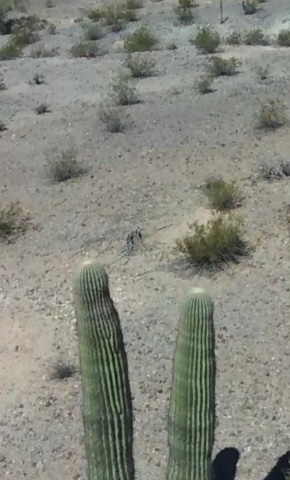
Photo of the top of a saguaro cactus
RETRACING OLD STEPS

Cactus tops, tree tops, house tops, my bald head are all things the drone and me have captured. I don't expect the novelty to wear off for a while.

In 1977 I entered active duty with the US Navy. I did a lot of traveling over the next six years. One of my more memorable trips was driving my then new Toyota Celica from Corry Station near Pensacola, Florida to my boyhood home in California. The 2209 mile trip took me around 44 hours. I remember bits and pieces of sights along the way. What I remember most though was how big and diverse the southern United States is.

In seven days I start driving from my home in Arizona to a conference in Orlando, Florida. I'll be in my new Honda CR-V. I expect to make a lot of stops along the way. I'm looking forward at what the drone's view reveals.

EPILOGUE

What the drone really does is expand my view just a little bit. My eyes are almost 40 years older than they were in '77. It occurred to me just now how Google Earth lets me look down. The drone makes it more personal, so much more up close. I think that's what an aviator might feel flying through the air. I'm not a passenger peering out a window at the world going by. I'm choosing the path and experience what's coming up.


Monday, December 28, 2015

Wanted Moster

INTRO

I used to be a Hagar the Horrible fanboy. The Dik Browne strip was a hoot and helped me get my day started right. One of my fav strips was where a bartender asks Hagar what he wants. His reply is something I cherish to this day.

WHAT DO I WANT? WHAT DOES ANY VIKING WANT?

Today's #ds106 daily create challenge was to produce a wanted poster.

Screen capture of a Plotagon animation

To get some ideas I googled "wanted poster". An animated poster of Have You Seen This Wizard caught my eye right away. So that's what I decided to make.

OUTRO

I love using my iPad to ideate and prototype. The daily create challenge helps me open up my creative mindset.


Sunday, October 25, 2015

Where The Teachers Are

INTRO

I spent Saturday October 24 with a roomful of ELA (English Language Art) teachers at the Arizona K12 Center. We learned about educational technology tools, including how to leverage them to support teaching to Arizona’s college and career ready standards. Disclosure: I’m not a teacher. I do instructional design.

IMPROVISATIONAL PD: FAILING TO GET IT RIGHT

Me not being a teacher is a good thing. I don’t know enough to keep quiet when something was introduced during the workshop. It’s all new to me. Except that it’s not. I learn a lot about K-12 strategies and educational technology at the EdCamps I participate in. Through some applied improvisation later on I figure out how to apply it with the adult learners I support.

I get asked sometimes why participate in so many EdCamps? I think I’m up to 30 so far: EdCamps in Texas, Arizona, California and Washington, DC. It’s because I like the improv. Hearing about something cool I want to try it right away, or as soon as possible, before it gets stale. I view doing something that I just learned from teachers as improv because I’m flying without a net. I don’t know what the cues are. Not being a teacher means I’m not sure about context. So I give it a try and add or drop stuff as seems to make sense.

OUT-OF-THE-BOX THINKING INSIDE OF A BREAKOUT EDU BOX

I hear now and then how we instructional designers need to be more innovative and creative. A lot of times the ideas that come back from “How?” involve advanced educational technology. Since EdCamp I prefer simpler more natural and humanistic approaches.

Photo of BREAKOUT EDU box


At CUEROCKSTAR Las VegasI learned about this Breakout EDU thing. The way it works is you get a box. But not just an ordinary box. Noooo. You get one with a sturdy hasp. About that hasp, it’s an electricians lockout hasp. There can be as many as six locks on this hasp.

Sketch of am electricians lockout hasp attached to a box

The teacher, or in my case instructional designer, crafts an engaging story. This is what teacher and author Dave Burgess calls “A Hook”. My name for it, after watching Jack Black in Goosebumps, is “The Twist.” Anyway, the learner or learners, once engaged, work to solve puzzles. The puzzles and their solutions are grounded in what the learner is being taught or trained on.

EVENT WHEN IT DOESN’T WORK IT WORKS OUT

At AZTEA’s P3: Problems, Projects, and Possibilities conference I presented a session on designing interactive presentations. One of the things I demonstrated was the Breakout EDU box. There were “technical difficulties”, however, and I had to do some improvisation to get over the bump.

Here’s how it was supposed to go. First there was the trailer. Then the backstory. Lastly was the vital clue. Anyway, given technical difficulties I had to play all the parts live. I got to feel the learning. It was pretty cool. I have a whole new perspective on how to do it next time. I’ll definitely have some backup stuff, too.

SCORE ANOTHER ONE FOR THE ZOMBIE (LEARNER) APOCALYPSE

One thing I need to work on, what teacher Chris Long calls Self-Development is the BOOS (Butts-Out-Of-Seats).

Tweet

I think, and some research studies suggests, learning efficacy can be deepened when learners are actively engaged and moving around doing learning activities.

THATS WHERE THE TEACHERS ARE

To review, why do I get most of my PD (Professional Development) from EdCamp & CUE? Because that’s where the teachers are.


Friday, September 11, 2015

Play Time PD

INTRO

EdCamp Tucson is tomorrow, Saturday September 12, 2015. Unlike many unconferences that I participate in this one’s practically in my backyard, only 90 minutes away. Usually I travel hundreds of miles to EdCamps. I reflect on what I might learn on the way there. On the trip home I reflect on how I might apply learnings to my instructional design practice.

PLAY TIME PD: A LEARNING ACTIVITY BEST EXPERIENCED WITH OTHERS

A few PD (Professional Development) conferences ago, it might have been CUEROCKSTAR, I heard someone describe PD as play time. I’ve been thinking a lot about viewing PD as a fun enjoyable thing to do.

When I was a child I loved when Papa would take me to the park. His experience and mine while at the park were, I believe, a lot different. Sometimes he’d bring the newspaper to read. Other times he’d watch me for a while then kind of zone out and relax. He worked in a Kaiser steel mill feeding coke into a blast furnace. I can imagine what relaxing in the shade of a tree in a quiet place meant to him.

How I experienced park play time depended on who was there, too. Sometimes there were friends I would run around with. Other times, probably more often than not, there were kids I didn’t know that I could get to know, play with, and learn from. Once in a while Papa and I would have the park to ourselves. I think he liked the quiet: me, not so much.

Fast forward to the present day: EdCamp Tucson. There will be lots of people there. It’s going to be held at CITY Center for Collaborative Learning. It’s someplace I haven’t been to before. Their website says it’s an “umbrella organization” but what does that mean? As it kicks-off we’ll post what we’d like to learn there. We’ll post topics we can facilitate conversations on. All this is standard stuff at an EdCamp; they have no preset agenda. Anticipating what will happen reminds me of my park experience. The best times, the ones that come back most vividly, are filled with memories of lots of kids interacting with each other in varied ways.

I was in Little Rock, Arkansas last week meeting with a development team. On my drive there and back, 2600 miles round trip, I stopped often to take pictures of interesting stuff. One of these times was near the village of Honobia, Oklahoma. It seems that every October there’s this Bigfoot Conference hosted by Christ’s 40 Acres.

Anyway, a little before Honobia was this big Bigfoot T-Shirt sign. I thought: “Kodak Moment”, so I stopped to take a selfie. Being alone it took a few minutes to balance my iPhone on the hood of my Pilot, set the timer so I’d have enough time to press the shutter release then run back up to the sign. I was huffing-n-puffing running back and forth trying to get the timing and my positioning right. Honobia is up in the mountains, high up. I was sweaty and breathing hard by the time I finally got it. Admiring the photo I took while I caught my breath reminded me of going to the park again: good times.

OUTRO

Why do I go to so many EdCamps and PD conferences? Is it for the keynotes? Is it for the pre-conference workshops? Is it for the concurrent sessions? Not really. EdCamps don’t have any of those things. The ATD conferences I’ve been to, the eLearning Guild’s DevLearn and mLearnCon have them and they’re informative and valuable PD resources. But where I really learn is when I interact with others. Talking about what their experience was like and then contrasting it with mine has the most value. How about you? Why do you participate in PD conferences?


Thursday, April 16, 2015

Be Long

PROLOGUE

AprilBlogaDay Day 16.. PLC & PLN and why they matter.

Collage of three photos including an irrigation ditch, a bag with the EdCampWestTexas logo, and a man standing next to a space alien totem

BE

Old news if you know me but worth saying again: The know-how and skills I learned during three months of EdCamp in 2013 got me home. Home, Mrs and me agree, is where I need to be.

LONG

From 2010 through early 2014 my job kept me far from home. I'm talking thousands of miles over that-a-way. Eager for new ideas to inform my instructional design craft I researched educational technology from my cubby in New Mexico. Up to that time, this was August 2013, I'd been active in my PLN (Personal Learning Network) on Twitter.

I participated on chats. I heard about stuff. Only it was mostly tried and true stuff. Don't get me wrong. The instructional strategies I heard about were practical, effective, and easy to put into practice with the learners I supported. But I could feel myself sliding slowly into a rut.

That was when I found my first PLC (Personal Learning Community). I'm talking about EdCampWestTexas.

Subtle: the difference between a PLC and a PLN I mean. It's subtle. As I get it a PLN is a gathering of like-minded people located some distance from each other. Social media apps like Facebook and Twitter enable them to come together virtually periodically. Occasionally individual PLN members might meet at an event. But for the most part their interests bring them together online for brief periods of time to share. A PLC is a group of people rooted in a place. It's easy for them to gather and share.

Because PLC members are mostly local to each other it's much easier for members to support collaborative learning, sharing, and making.

Most of the PLCs I consider myself a member of are a long distance away. Still, I am motivated to go the distance for the deeper learning I know I'll find with them. PLCs are communities of practice. I suppose one could argue distance is relative. If it's worth it you'll belong.

EPILOGUE

EdCampNavadota (Texas) is this Saturday. I had planned to go the distance and participate. As it happens my work requires me to be elsewhere. I'll still get to learn from members of my PLN that do attend. It's going to be amazing.


Monday, January 19, 2015

Outtakes and Sense Making

PROLOGUE

"Got to pay your dues if you wanna sing the blues" -- R. Starr & G. Harrison

OUTTAKES

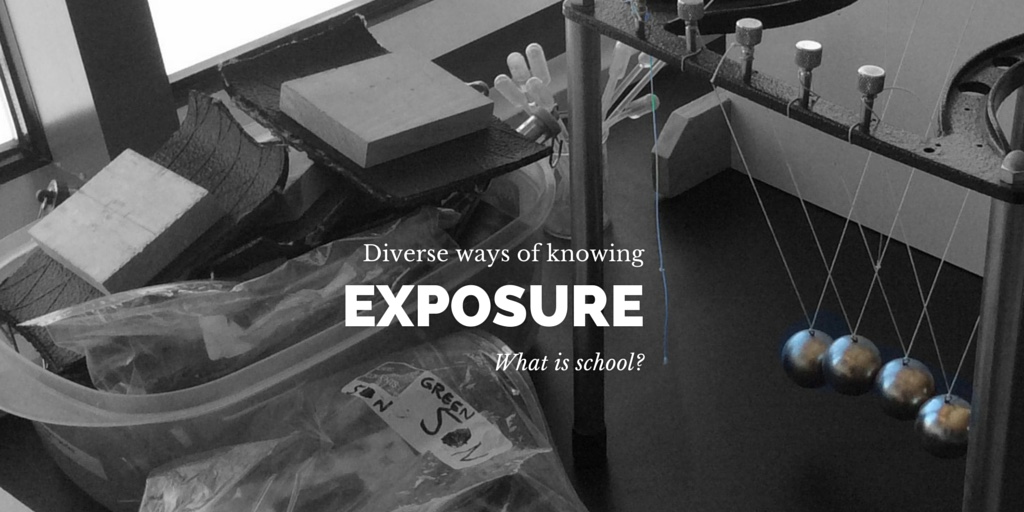
What is school? School is being exposed to diverse ways of knowing (and questioning everything).

Photograph of Newton's Cradle
My professional development journey went off on a tangent today. More often than not that's how I seem to learn best. What force launched me in a new direction? Questions 1 to 3 of a Twitter book club chat with the hashtag #lrnbk. The book? Kio Stark's Don't Go Back To School.
Screen capture of Twitter chat #lrnbk

Positive deviant that I am I may have tweeted my response too quickly and been misunderstood.

Screen capture of tweet

SENSE

Stark's writings make sense to me. One's development isn't, and shouldn't be, confined by walls, syllabi, or accreditation. I'll go a step further: Learning should know no constraints at all. Stark is saying there are constraints. The institutions of higher learning offer education on a range of topics. Employers require documentation that a specific type of learning has happened. Individuals need something to frame.

I've had several careers: electronics engineering, military service with the US Navy, programming multimedia, and learning and development. At heart I am a problem solver. Ms. Stark needs to restate the problem. I disagree with her about misfocused energy.

Consider what is happening in the K-12 space. Significant educational problems are being talked about and more.Educators are collaborating to make learning experiences better. Many of the people I meet there are actively involved in growing their know-how through exposure to diverse ways of knowing via higher education so that model of learning and development still works.

In the trenches there are teachers like Dave Burgess (@burgessdave) advocating for more engaging ways of presenting the learning experience. Teachers Erin Klein (@kleinerin) believe that the learning environment matters. Teachers like Don Wettrick (@donwettrick) are giving students the opportunity to choose their own path to learning. All one has to do is visit an #EdCamp to see this energy in action.

MAKING

I went through school in the 1960s and early 1970s. Back then learning was mostly rote memorization of facts and formulae. Worksheets figured in the learning process, too.

What are the limits of school? I think Stark is asking the wrong question. She needs to tweek its focus a little and ask what is school? One of Webster's definitions for school, the one I identify with the most, is "a source of knowledge." Maybe it's in a building. Maybe it's online. For me it's something that changes me: How I perceive the world around me. The change can and does happen any where at any time.I don't get why one would want to highlight those whom choose another path. They are everywhere.

  • The coworker lamenting about a missed promotion
  • The parent volunteering at their kid's school
  • The supermarket cashier with a textbook tucked under her lunch bag
We are learning. All you have to do is look up at yourself and the people around you. If you're not having a conversation with those around you then you should consider starting one.We still need something to frame. If you're so inclined and not currently engaged in another form of learning give Todd Nesloney's (@techninjatodd) Educator Learning Series (#EDULS) a look and learn and earn.

Screen capture of Credly badges

EPILOGUE

I have an M.S. Ed. I made a couple of tries for a Ph.D. before putting it on indefinite hold. You know what? It's hard. No, that's not it. Not really. It got to be uninteresting. Like one of Stark's highlights I chose a different path. And, whether you realize it or not, you have too.

I wonder what path today's K-12 students might choose?


Tuesday, December 30, 2014

Expeditionary Mettle

PROLOGUE

"To all whom see this presents, greetings." -- Introductory text contained in my US Navy Expeditionary Medal citation.

Photo of US Navy Expeditionary Medal on a notebook cover
US Navy Expeditionary Medal

EXPEDITIONARY

A long time ago in a land far, far away I went on an expedition. It was challenging and, decades later I can say this, fun. Recently I've gone on a few more expeditions of the professional development variety. Some of these, trips to EdCamps in other states for example, require me to travel a long way. Others I can complete using my iPad. One of the latter I finished a few minutes ago: reading @quinnovator's Learnlet blog. In it he discussed, with Dr. Will Thalheimer, instructional design tools, processes, and challenges.

My takeaway from this Learnlet is the tendency of today's Learning and Development (L&D) infrastructure and tools to dictate how training is designed. Some times these strategies are effective and other times designers should consider taking a trip to learn how others are approaching their work.

METTLE

One topic discussed in the blog got my ideation juices flowing: spaced learning. Learners are introduced to a bit-o-content for a brief time then go on to another topic. Some time later they return to the first topic and take the learning a little deeper.

Sketch containing text describing several types of training to include soft skills, process knowledge,and other
Artifacts learners can produce during training

I outlined how I like to design spaced learning experiences in the sketch above. Ideally they involve learners in small teams of no more than three. They learn a little of this and then a little of that. Along the way the learners create a tangible artifact from what they learned. In a soft-skills leadership development program this could be a table of scenarios they might encounter later on the job. It would help them work towards a solution more efficiently.

Some benefits of this sort of spaced training include:

  • Not being tethered to a learning space they can move around and manipulate materials on hand to prototype ideas. This lends itself to elearning and collaboration.
  • Learning from others perspectives.
  • Forming relationships with peers that may continue after the training. With some additional support they could form communities of practice.
  • Having a tool that helps them get started when they begin to apply on the job what they learned.

Another name for these artifacts is performance support tools. You're probably applying bits and pieces of this strategy today.

EPILOGUE

The journey doesn't end here. What are your thoughts on applying spaced learning in your instructional design practice?

@urbie


Sunday, November 9, 2014

It's People: PD Is People (and the connections and things they make)

Prologue

I've been known to go way off the beaten path to learn new stuff. Though I own a GoPro camera I'm not too into extreme things to do. Extreme for me means going the (usually long) distance to connect with people and their ideas and ways of doing.

PD Is People

The past year or so my professional development (PD) has come from sharing ideas and ways of doing with other educators far from my home.

photo collage of learning events

Yesterday, for example, I participated in EdCampUCLACenterX in Pico Rivera, California. The school where it took place was an hour's drive from the town where I grew up. The school's architecture and layout reminded me a lot of good 'ol Colton High. Someday I'd like to participate in an EdCamp there. Who knows?

That's why I go the distance for PD: lots and lots of diverse perspectives in safe and familiar environments. Yesterday during the Technology and other checking for understanding session I was asked how different the EdCamps I've been to are from each other. I replied that the focus of the sessions changes. Or maybe because it's the times that are changing. Certainly the district and state environment affect what teachers are interested in learning.

I love meeting new people. I worry sometimes that I might be a little annoying, as I like taking a lot of pictures. I generally ask permission, at least of those nearby.

One thing I think that most everyone I've met at the PD events I've gone to in the last year (DevLearn, EdCamps, COMPILE) share is the need to keep the conversations going. "How do we maintain the relationship?.

Connections

This guy: Jed Butler knows Twitter PD.

photo of Jed Butler explaining Twitter chats

In the space of about 20 minutes he spun the most amazing series of short stories about how Twitter PD changed his life and how it can change ours. He took us step by step from starting, to sharing, while pointing out some awesome resources like Cybraryman1's site along the way

Epilogue

I'm hoping to be able to visit Austin, TX next week for EdCampATX and Los Angeles early next year for EdcampLA. Then there's the San Diego CUE but it's the same day as EdCampATX. Try and go out and meet some people: learn something new whilst growing your personal learning network (PLN).