Showing posts with label emotional intelligence. Show all posts

Wednesday, March 16, 2016

Turned Around

PROLOGUE

Sunday morning my best laid plans for getting to the Learning Solutions conference in Orlando, Florida got turned around. News about flooding in Louisiana and Mississippi, my direct route, and word of more of the same on my alternate route through Arkansas encouraged me to play it safe. So I made it as far east as Austin, Texas and and turned around for home.

GIVING MYSELF THE GIFTS OF TIME AND FLIGHT

In Austin I decided to try for my alternate route through Arkansas. Increasingly dire warnings on the news and Facebook friends postings about heavy weather nixed that idea. I emailed the conference producer that I wouldn't be able to make it to present my session. I felt a kind of despair for a little while. What made the fear fade was hearing from a friend that I needed to ask God for guidance then decide then let go. So I did.

A hundred miles west of Abilene, Texas for no particular reason I pulled off Interstate 20 and walked around a bit. I had my BeBop drone with me. I wanted to take it aloft but was cautious as it was windy. In the end I let it fly. And then I was rewarded by this photo.

Photo of tilled soil with tire tracks turning away from a weedy field

I decided then to go off the Interstate. I got to visit several very small Texas towns. I experienced life through others' lenses. I flew my drone under a bridge over the Pecos River. I got to look down into what I think was a mine entrance. I fumbled a bit trying to fly over and around a moving train. I have to work on being steady at the controls though. But I did get to peer down into some of rail cars passing below.

EPILOGUE

A few days before Christmas 1977 I decided to take a couple weeks leave from my posting at the US Navy's training command at Corry Station, Florida. Early one Saturday morning I packed my sea bag into the trunk of my lemon yellow Toyota Celica and headed west on Interstate 10. My goal was spending the holiday with my family in Colton, California some 2200 miles distant. I recall it was quite foggy as I sped along. Around Mobile, Alabama it started to rain. Hard. It continued to rain well into Louisiana. The gas stations I stopped at to refuel were inundated by water. In Louisiana there's this long stretch of Interstate 10 that's elevated. I have a strong memory of my Celica and me hydroplaning over the flooded bayous. By the time I got to Beaumont, Texas the clouds and rain had mostly given way to clear blue sky. Topping off at a Texaco station I asked the attendant how long to El Paso. His reply remains vidid in my memory: "Worry about that tomorrow."

So here I am, my 60 year old self, enjoying another tomorrow. I have time.


Saturday, March 12, 2016

5 a.m.

INTRO

It's 5 a.m. on a Saturday. I'm on a path that I'm not sure where it goes.

FADED PHOTOGRAPHS OF VIVID MEMORIES THAT MAY NOT HAVE HAPPENED, YET

I'm on my way to #LSCon, the Learning Solutions Conference, produced by the eLearning Guild. But that's not what this post is about. I'm on my way to Orlando, Florida where the conference is held. To get there I have to travel along a path from my distant past.

The end of 1977 found me at Corry Station learning the finer points of being a technical sailor in the US Navy. Corry Station, in ancient times, was a naval air station. I have a vivid memory walking across the old runway apron and tripping over an old aircraft tie-down cleat. It was set, recessed, into the concrete, a small loop of rusted iron. At least that's how I remember it. I think I took a photo of it. If I did I lost it. It isn't in my Flickr, one of the apps I use to record photos.

Screen capture of a grayed-out Flickr screen

At this very moment I'm in El Paso readying myself for today's travel. I'm connected to the Internet via a 3G Verizon mobile device. In its day it was fast. Today it's like molasses. A few minutes ago I was in Flickr looking for old photos. After about two years of pictures the screen turned gray. The photos are there, on a server somewhere, but not here in front of me to verify my memory.

I hope to travel 600 miles today just like I did yesterday. Except that yesterday I barely made it 400 miles. I kept stopping, for reasons of health and curiosity, to pass some time among memories. I flew my BeBop drone to give me a perspective I didn't have back then. If you follow me on social media expect lots of fisheye views of the ground from 30 metres up the next few days.

OUTRO

In 1977 parts of Interstate 10 hadn't been completed. Today, I hope to find a detour I took around one such unfinished section. Only I'm not 100% sure where it was. One end was at Fort Stockton, Texas. I recall a cattle watering tank and an ancient Ford Aeromotor (a windmill). If I find them, expect a flyover. If I can't find it maybe I'll do a sketch of the vivid memory of something I think I saw 39 years ago for a moment.


Saturday, March 5, 2016

Hey Aviator

PROLOGUE

I'm an aviator. Ok, not really. But I do wear glasses and own a drone quadcopter. The point is I drive something that flies.

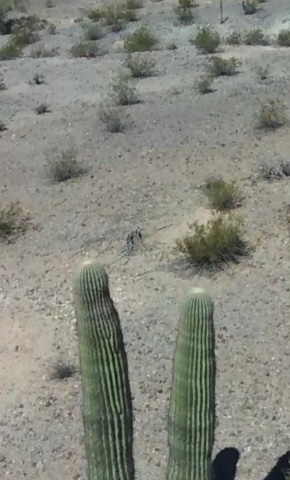
Photo of Bebop 2 drone in flight next to a saguaro cactus

HOW LOW CAN YOU GO?

For as long as I can remember I've wanted to _______. But I have a short attention span. It doesn't help I'm attracted to shiny objects. So along the way of my life I've half started a lot of things. But now that I'm an OldPa (a term I remember from an old Lionel Barrymore as grandfather movie) I have a little more disposable income.

So the other day I used some to buy a Parrot Bebop 2 drone. I needed one to respond to an RFP (Request For Proposal). Now that I've responded I have a cool red toy to play with.

Speaking of play, I like to have fun while learning. One way I have tons-o-fun learning is by participating in EdCamps. In a nutshell they're gatherings of teachers where everyone is a genius. I've lost count of how many I've participated in. Anyway, at one of them I noticed how learning can be influenced by environment. I was in a first grade classroom. Not only was everything small, like models I glued together as a boy, most things in the room were scaled down, maybe 3:1. I had expected that.

What I hadn't expected was how low things on the wall were. I'm 6 feet and 5 inches tall. I had to look down at learning aids placed on the walls. Something a six year old looked straight into I had to peer down at. This has AHA! moment kick-started my thinking on learning environments.

THE TOPS OF THINGS

When I spun up the props on my Bebop and got it about three metres in the air I saw a whole new world. Tall as I am I mostly look down at things. Of course I look up at stuff too. But being a creature of habit I tend to not really notice the usual stuff around me. Taking a look at my surroundings from higher up than usual really opened my eyes. Cliche though it may be to say I saw a whole new world it's true.

Photo of the top of a saguaro cactus
RETRACING OLD STEPS

Cactus tops, tree tops, house tops, my bald head are all things the drone and me have captured. I don't expect the novelty to wear off for a while.

In 1977 I entered active duty with the US Navy. I did a lot of traveling over the next six years. One of my more memorable trips was driving my then new Toyota Celica from Corry Station near Pensacola, Florida to my boyhood home in California. The 2209 mile trip took me around 44 hours. I remember bits and pieces of sights along the way. What I remember most though was how big and diverse the southern United States is.

In seven days I start driving from my home in Arizona to a conference in Orlando, Florida. I'll be in my new Honda CR-V. I expect to make a lot of stops along the way. I'm looking forward at what the drone's view reveals.

EPILOGUE

What the drone really does is expand my view just a little bit. My eyes are almost 40 years older than they were in '77. It occurred to me just now how Google Earth lets me look down. The drone makes it more personal, so much more up close. I think that's what an aviator might feel flying through the air. I'm not a passenger peering out a window at the world going by. I'm choosing the path and experience what's coming up.


Tuesday, February 23, 2016

Conf it up

INTRO

What do you do when the concurrent conference session you were really interested in falls flat?

THE LEARNER IN THE MIRROR

I've done it. I'm in a conference session whose title and description really resonated with me. But then a little into it I catch myself browsing the web on my mobile device because the actual presentation isn't all that interesting.

Image of distracted listeners

Over the past 12 months I've gone to a dozen or so conferences. Most were EdCamps; the others were sponsored by professional development organizations.

As a presenter it stings when I don't connect with the people in the room. Heads go down and it's plain they're doing something else. Mea culpa. Reflecting on this on the long drive home from EdCampVentura Sunday I wondered how a presentation might play out if it was more conversational. That's where the root of conference comes from: conversations among people brought together by similar interests.

OUTRO

When a presenter asks their audience to put their mobile devices away are they doing it to avoid disruption? Or might they be saying, "What I have to share isn't all that interesting." Maybe an appropriate response is following that basic tenet of EdCamp: Vote with your feet.


Tuesday, February 9, 2016

An Old Dude Gets Whyze

INTRO

In my personal life rarely do I have a plan.

GIVING UP CONTROL MADE ALL THE DIFFERENCE UNTIL IT DIDN'T

A basic tenet of EdCamp is to vote with your feet. Not getting what you came for? Vote with your feet: Let them take you where you might.

Almost 40 years ago I gave up control of my life for six years. At 20 I enlisted in the US military. In the Navy to be precise. I made choices, sure. But for the most part others made the decisions. Except they were really my choices. Confused? So was I. At least until I read a blog post by @davidtedu on a writing technique known as The Three Whys. The way I figure it asking why three times takes one deeper into a subject. This allows one to glean insights that might have been missed during a more conventional process of analysis.

Why did I join the Navy? To have an adventure. To have a chance at living a life beyond the commute here and there existence I'd known for far too long. Why did I want adventure? Because I felt my life to that point resembled a connect-the-dots puzzle where predefined forms reveal themselves after a period of focused effort. The point is the forms were there all the time. It was live by the numbers 28-29-30 and there you are hello Mr. Easter Bunny. Why do I have a problem with numbers? Because life isn't about counting. Life is more about formulating. And there I got brought up short. Because I don't like to plan. If I really believe in formulating, in thinking deep thoughts and applying, them isn't that planning, which I have mentioned I'm not a big fan of?

AN IDYLLIC YEAR LIVING IN A JUNGLE

Diego Garcia. I spent one of the best years of my life there. Located a little off the equator in the Indian Ocean it's a coral atoll and jungle. The thing about jungles is they smell. Jungles smell bad. It's because jungles are in continual renewal. Old stuff falls to the jungle floor where decomposes. It feeds new life. I had to travel something like 11,000 miles from home to learn that lesson.

I got there after a week riding a C-141 transport plane all the way from Norton AFB (Air Force Base), to Travis AFB, to Hickam AFB, to Anderson AFB, to Clark AFB, to.. Trust me on this point: It took a whole lot of tos to get me where I wanted to be.

Collage of images
Which brings me back to choices. Diego Garcia in 1978 was isolated duty. I volunteered to go there so the Navy obliged and sent me. I learned that I could usually get what I wanted by asking for stuff few wanted. It wasn't a plan. It was a formula.

UP UP AND HEY

I've voted with my feet twice in the last couple weeks. At Design Camp San Diego and EdCampPerris I listened for a time then got up and moved on. What got me moving was a static message, a conversation where one person was doing most of the talking. I know this as teaching. What I'm much more into these days is learning. It's like traveling by air. You can get there slowly by balloon. To go the distance, to make the big leaps, takes oomph, the sort of thing a rocket is good for. The great thing about EdCamp are conversations, where everyone speaks up and shares. It's a kind of design thinking. Everyone speaks up. Different things resonate with different people. Bonds of empathy bring people together for deeper collaboration.

OUTRO

So I asked why a few times and I got whyze. With this whyzdom came the realization that I don't much like being told how something works. I'd much rather listen to a multitude of others share how they think something works and then try it on for size so I can figure out how it works. Thank you David for why assist.


Saturday, December 26, 2015

Pains of Glass

INTRO

I spent most of the morning after Christmas looking out my back window and sketching. My mind, free to wander and wonder, eventually coalesced around a pane of glass

INTO THE AIR WE EVENTUALLY THRUST OURSELVES

I used to make a mean paper airplane. It was fun experimenting with folds and tossing them into the air. Some flew mostly straight. Other planes flew erratic paths in the air.

Sketch showing the launch of a paper airplane into the sky
Somewhere, sometime, I remember someone telling me there would come a time when I would have to put aside my childish things. So at some point in my life I did.

Now, many years later I find myself wondering, is there a difference between childish and childlike? As usual when my mind drifts too far afield I ask Mrs for her perspective. What usually happens is while she's sharing I either have a sudden AHA! moment of crystal clear insight or my thoughts go off on an unexpected tangent.

Today it was a sudden insight that brought understanding. Childish suggests something having to do with one's maturity. Caught with my hand in the cookie jar do I deny it's my hand or do I ask, "Want a cookie too?" Childlike, on the other hand, speaks to innocence and wonder.

OUTRO

It's sometimes painful when I look back and recollect. What might have been, if.. I used to think they were cognitive excursions of the wasteful kind. The past is immutable, right? But of course they're not wasted. Reflections can lead to the old seen in new ways and to new directions.

Which brings me to my granddaughter Carly. We light up when we see each other. I've mostly given up sharing things I know with her. We both get more out of our time together when I experience what she shares with me. I like being childlike alongside her. Problems I'm working on seem smaller when I see them as I think Carly might. No pane, no gain.


Tuesday, December 15, 2015

Experience It

PROLOGUE

Bored, the boy took off his watch and began fiddling with it whilst the teacher droned on about predicates. Turning his head he gazed out the window at the concrete playground. Lost in a daydream playing ball with his friends his watch, somehow, found its way into the cuff of his uniform pants. "Five more minutes. Please God make the time go faster." the boy prayed as he stared at the clock high up on the wall. "My watch! Where did it go?" he thought as he sat up suddenly, his face worried. His right arm shot up, hand waving frantically trying to gain the teacher's attention.

LEARNERS EXPERIENCE LOSS EVERY DAY

This actually happened. A few days after Christmas Break in 1969 I lost my watch. The sister, at Our Lady of Guadalupe School teachers were nuns of the Incarnate Word Order, when she noticed my raised hand smiled. Maybe she thought I was going to ask a question predicated on predicates? Sadly, we'll never know. What I do know, much to my embarrassment, was what happened next. After I told her I'd lost my watch she asked the class to help look for it. Before anyone could start Peter, sitting at his desk in the row next to mine said "He stuffed it into his pants cuff a few minutes go." What do you think happened next?

Sketch of an online student hunched over a desk with a door open to the night in the background

I learned lots of stuff in school. Reflecting on my experience now, so many years later, it surprises me that I did. I mean so much of the time in class I was daydreaming.

Fast forward to now: I finished watching George Saunders: On Story. My takeaway from his talk, I watched it several times, is that story is experience boxed up. Opening the story exposes someone to wonder. Being individuals we appreciate the story based on our experience. So I reflected on this a little more and connected some dots.

What if an online learning experience was more about story than facts? I'm taking HumanMOOC at the moment. I'm learning how to make online learning experiences a bit more learner friendly and engaging. The course is presented in two modalities that I don't completely understand. One is instructor directed whilst the other, I think, is learner directed. As usual in school the subject matter is chunked into lessons or modules the thought of which makes me shudder. They're artificial structures designed to make it easier for.. sorry, I'm going off on a tangent that has nothing to do with my story.

Except that it does. When a student is engaged in her learner experience hours can seem to pass in a blink. In this MOOC I'm put off by the structure of the first modality and confused by the second. The dissonance I feel makes me seek a third learning mode: rhizomatic learning. It's where I come up with a question and go in search of stuff. Sometimes I find answers. Most of the time what I find is more questions.

This is where the magic happens. Rather than poring over media the course designer and/or instructor thinks will provide learning I go on my own way. I don't believe it's serendipitous. It's purpose driven. It's my purpose that motivates me to go out and learn based on my own needs via my own resources.

EPILOGUE

My face, I'm told, flushed the deep red associated with life-threatening embarrassment as sister bent down to retrieve the watch from my pants-cuff. Geez that memory comes back so clearly despite the passing of almost 50 years. How might we leverage story to build life-lasting knowledge and skill? Might it encourage learners to open a door and, curious, go out into the night and experience it?


Friday, May 29, 2015

EdCampUSA Reflections

PROLOGUE

"When the student is ready the teacher will appear." -- Buddhist Proverb?

EdCampUSA

Out of focus photo of several teachers and a laptop

Friday May 29, 2015 saw me keeping company with educators at EdCampUSA in Washington, DC. It was quite a the learning experience. My PLN (Personal Learning Network) grew a few sizes whilst I listened and shared.

REFLECTIONS

I'm going to be thinking about the stuff I learned today. Chief among these includes wearables in education, student voice, and caring enough to figure it out. Not for the first time something occurred to me along the way. Some of what I heard wasn't new. Maybe it was deja vu? Or perhaps I was rehearing something I had heard before and set aside. I can't say for sure. But engaging with peers in conversation and chiming up when I had a mind to made for an exciting time.

EPILOGUE

Brad Pitt, in World War Z, said something to the effect of, "Movement is survival." I think he said it. Any, I think of learning in a similar way. I have to put myself out there where others are. Deja vu or new doesn't really make much difference. When the student is ready learning happens and stuff begins to make sense.


Wednesday, April 15, 2015

Social Earning

PROLOGUE

Good news bad news: learning in collaboration with others via social media can be amazing when learners(and their organizations) engage.

SOCIAL

Learning in the company of others offers learners a significant benefit. Individually they learn from gaining and applying their own knowledge. In groups learners benefit from insights triggered by others sharing their perspectives.

A traditional classroom's capacity may constrain group learning. Environmental issues might hinder social learning as well.

Photo split horizontally with a toddler above and cactus below

EARNING

Learning via social media removes some of the constraints. One, with walls gone you can share knowledge with as many others as you can network with. You can leverage technology to share perspectives across a variety of media: writing, videos, podcasts to name a few.

To benefit from social media learners have to invest themselves in it. Thinking about learning as earnings they have to work at it.

Social media can be a thorny issue for some organizations. Some I have produced learning experiences for have strict policies in place on how social media can be used. Others may prohibit it completely. There are cultural constraints as well. Things people share online via social media is visible. It takes a lot of trust for this exchange to happen.

EPILOGUE

Trust is the currency of learning with social media. When the trust is there learners are motivated to share. My job is designing training that leverages story, what some might call case studies, to hook learners interests and empathy. I keep advocating for it, designing it in where I can. We're getting there.


Saturday, November 1, 2014

It's a small world after all

Prologue

I got back home Halloween night. I'd spent the back half of last week attending the eLearning Guild's DevLearn Conference 2014 in Las Vegas, Nevada. I had a few minutes to unload and unwind before Mrs got home from work. So I started in on The Empathy Era by Belinda Parmer, CEO of Lady Geek, a creative agency in the UK.

computer generated graphic of several glowing jack-o-lanterns
I'd barely opend it when an infographic caught my eye: There is a direct link between emotional intelligence and salaries (Bradberry and Greaves, 2009). Thinking about this made me want to know more, so I googled emotional intelligence. Which led me to a recent article in The Atlantic about its dark side. Which, after I'd read the article, was a good thing. There are shades of gray in everything. This is why teaching critical thinking is vital.
This train of thought made me wonder where learning critical thinking should happen: at school, at home, or on the job? For me the answer was everywhere, because as I'd learned at DevLearn context is crucial. In school the responsibility for teaching critical thinking to students falls squarely on teachers' shoulders; or does it? Students have a responsibility to own their learning, too. Teaching it to workers on the job falls on, well, the people who design learning experiences: instructional designers like me who work in L&D (Learning and Development). As in K-12, learners have to own their development, too.
Some time later I ended up on Connie Malamed's website reading an article about 10 ideal qualities instructional designers should possess.

K-12 and L&D

I thought, when I began a #madwriting session early this afternoon that this Connect the Dots blog post would be simple. Only it's not. It's nuanced, in this case, because I think instructional designers are educators in the way that teachers are educators.

As I read Malamed's post and the 10 ideal qualities instructional designers should possess the thought, more than once, crossed my mind that the list reminded me of the teachers I met at every EdCamp I've ever been to.

I was a little let-down then when I googled 10 qualities for an ideal teacher. It's not that I didn't find many qualities that both designers and teachers shared. The instructional design qualities seemed to reflect mostly technical intelligence. Teacher qualities appeared to be grounded in emotional intelligence.

One of the teacher better lists came from the Queensland, Australia Department of Education. Being the sort of person I am, a recent convert to the Teach (Design) Like A Pirate discipline, the quality that leapt off the screen to land in my lap was enthusiasm. This felt like the passion I've come to understand makes me want to be better at my job.

Then I went off on a tangent and googled a third time: qualities of an ideal student. I was surprised to find this EdTech Review article from last year about 21st century classrooms. It screams instructional design.

Where does this rhizomatic excursion leave me? Are instructional designers educators like teachers? It depends. If the designer is passionate about what they do and pushes their holistic selves to create an environment where learners can take on more of the responsibility for their education then yes, they are educators. The emotional intelligence, empathy for learners, is what really matters. It's the teachers' context.

Epilogue

Here and there as I wrote this I kept going back to The Empathy Era. It was a good thing, too. Because at the end of Chapter One, at the end of the last paragraph was a sentence that made me shiver with excitement. It was about putting yourself in another's shoes, seeing the world through their eyes, and providing them with something that they didn't know they needed.

I had the good fortune to have been selected to present Applying K-12 Strategies and Technology in Corporate Learnng at DevLearn. What I learned there validated my decision to participate in EdCamp professional development. We share a passion for learning.

photo of Belinda Parmar and Urbie Delgado talking

And you know what? It's a small world after all. At DevLearn I met Belinda Parmar, author of The Empathy Era. Whilst waiting to meet her I got to speak with Kristen, another DevLearn attendee. She said that a previous DevLearn event had changed her life. I know the feeling. This one changed mine.

References

Bradberry, T. and Greaves, J. (2009). Emotional Intelligence. San Diego: Talent Smart.